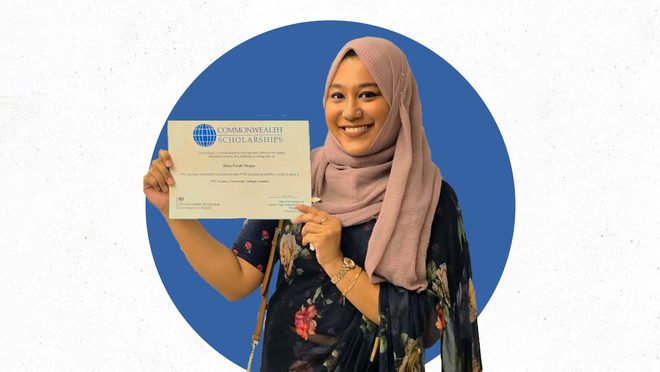
How Zeba turned years of research into a Commonwealth Scholarship
For many young researchers, a prestigious international scholarship can feel like an opportunity meant for someone else. For Zeba Farah Haque, however, becoming a Commonwealth PhD Scholar was not the result of one extraordinary achievement, but the culmination of years of growing commitment to questions that matter to Bangladesh.
From studying law at BRAC University, BUP and Kent to working on human rights, climate change, migration and access to justice, her journey gradually brought her to a research question at the intersection of climate change and human rights.
Now preparing to pursue her PhD at University College London, she reflects on the application process, the self-doubt behind it, the people who supported her, and what she hopes to bring back to Bangladesh.
By the time she seriously considered applying for the PhD scholarship, her academic and professional journey had already begun to make sense as a whole.
“I had already studied Environmental Law and Human Rights at Kent, conducted research on cultural rights, heritage, climate change, and migration, and returned to Bangladesh to teach law. Before that, I had worked at the Centre for Peace and Justice at BRAC University on issues including refugee rights, prisoners’ rights and paralegal implementation. So, when I looked at what the Commonwealth Scholarship was actually looking for, not simply academic performance but research with a clear connection to development and an intention to bring that knowledge back to one’s own context, I thought, perhaps for the first time, this is something I can aim for.”
That did not mean Zeba thought she would get it. There is a very big difference between being eligible to apply and actually getting it, as the selection process is extremely rigorous and competitive, but she also felt that she would regret not trying. Zeba already had a research problem that mattered deeply to her, and she knew exactly why she wanted to study it. So, her school of thought was something like she may not receive it, but she has reached a point where she has a legitimate reason to put herself forward.
Upon reflecting on what Zeba’s application journey actually looked like, from the first step to finally receiving the award, she said, for her, the application did not really begin with filling in the Commonwealth form. It began much earlier, with figuring out what Zeba genuinely wanted. She was simultaneously working on the research proposal, identifying universities and supervisors whose expertise genuinely matched the project, preparing university applications, thinking through references, and then translating all of that into the Commonwealth application.
The scholarship application required a slightly different mindset from a university application. A university wants to know whether you can conduct doctoral research. The Commonwealth application also requires you to explain why that research matters beyond the university, particularly what it means for your home country and what you intend to do with the opportunity afterwards.
Alongside these, when you have a research problem, you do not really know what the exact outcome will look like, because that is what a PhD is about: figuring out your answers over the course. So, Zeba found that part challenging, not because she did not have an answer, but because it is surprisingly difficult to explain something you care deeply about in a very limited space without sounding exaggerated.
“There was also a lot of waiting. That was probably psychologically harder than filling in the forms,” she said. You submit something into an extremely competitive process and then continue with your life without knowing what is happening to it.
“If I were explaining the process to someone applying for the first time, I would say: do not think of it as one scholarship form. Think of it as building one coherent case: your previous work, your proposed research, the university and supervisors you have chosen, the problem you want to address, and what you intend to do afterwards all need to make sense together.”
Zeba academically had a strong record, which of course worked well for her. She received the Vice Chancellor’s Gold Medal for both her LL.B. at BRAC University and LL.M. at BUP, as well as the Dean’s Award and a fully funded scholarship at Kent. She had also published research and had a fairly substantial background in international mooting. But many Commonwealth applicants have excellent academic records and publications. She considers what may have strengthened her application was the continuity and coherence between different parts of her profile.
What also gave the research a very personal grounding was that those questions did not come from the literature alone; rather, they grew out of realities she had seen in Bangladesh and gaps she had noticed in how her existing legal and policy frameworks respond to them.
“My research interests were not suddenly created for the scholarship. I have written and presented on climate refugees, environmental responsibility, corporate environmental degradation, migration and minority rights. My professional work involved refugees, access to justice and community-based legal work.”
Thus, when Zeba said that she wanted to identify the relationship among all these, and eventually contribute that knowledge through research, teaching, and policy work, it was all connected and pointed in one direction. Zeba’s research was not just if she had to identify one strength but probably coherence.
“My application had a story behind it that, once put together, makes full sense.”
Zeba’s PhD proposal broadly focuses on climate change and human rights in the context of Bangladesh. It was not something she developed specifically for the Commonwealth application; rather, it grew gradually from questions she had already been exploring through her previous academic and research work.
“During my time at Kent, I worked on issues sitting at the intersection of climate displacement, environmental protection, and human rights. I was also increasingly drawn to the broader human rights implications of the climate crisis, particularly how climate-related impacts can expose gaps in existing legal and policy responses.”
Over time, those interests converged and eventually formed the basis of Zeba’s doctoral research and her primary research question.
The connection to Bangladesh was not something she added later to make the proposal more relevant. It was central to the project from the very beginning because Zeba wanted the research to respond to a real issue in her own country.
Several times, Zeba felt that her application might not be strong enough. And strangely, having a reasonably strong academic record does not necessarily make that feeling disappear. Sometimes it made her more aware of how strong everybody else applying probably is.
There were periods after submitting the application when she mentally prepared herself not to receive it. This year, the FCDO has particularly reduced the number of awardees. Therefore, she knew that academic grades alone would not be enough. She had a constant feeling that her application might not be good enough, but what helped her keep going was reminding herself that selection was not something she could control. What she could control was whether she had put forward the most truthful and coherent version of her work.
By that stage, Zeba had invested years in the questions behind it. She received serious interest in the project from universities, culminating in a fully funded PhD opportunity at Queen Mary that helped her to realise that even if one particular scholarship did not work out, the research still had value. So, there was definitely room for self-doubt.
“I do not think confidence means believing that you are certainly going to succeed. For me, it meant continuing even when I genuinely did not know whether I would.”
Zeba ultimately chose UCL, while she also had a fully funded PhD offer from Queen Mary University of London. Upon asking what made UCL feel like the right place for her, she said it was genuinely difficult to choose as Queen Mary had also offered her a fully funded PhD opportunity. She also received an offer from the University of Durham, and she could attend Durham with her Commonwealth PhD Scholarship. These were extraordinary opportunities in themselves, which made the decision all the more difficult for her.
So, her decision did not simply rely on, “Which university is offering funding?” or “Which university has a better ranking?”
After putting a lot of thought and much deliberation, she chose UCL because the combination of the supervisor’s expertise and the wider intellectual environment around environmental law, climate-related questions and the kind of interdisciplinary work she wanted to undertake felt well aligned with the project.
Queen Mary and Durham made the decision much harder rather than easier, because she was choosing between three genuinely excellent opportunities. And to date, Zeba remains enormously grateful to Queen Mary and Durham for their trust in her research proposal, which helped her to believe that her project does have value.
Zeba did not consider there was only one academic or mentor who gave her a single piece of advice that magically changed her scholarship application. A PhD application is very individual, and every research project is different, so there is only so much one person can tell another about how to do it.
What mattered much more to Zeba was the support system around her. She is thankful for her husband’s support, as he always made her believe that she could do it.
“As my husband is also a Barrister and is currently pursuing his master’s degree at the London School of Economics, he understands firsthand the pressures that come with demanding academic and professional goals.”
There were times when Zeba was genuinely exhausted and wanted to give up. The application process was long, demanding, and at times emotionally draining, but her husband always believed that she was capable of earning the scholarship.
A PhD is a very independent journey. There is no single piece of advice that will get someone a scholarship. Every research project is different, and so, it is not possible for one person to guide another, but what mattered to Zeba in this very tiresome and cumbersome journey was the faith her family had in her. She was going through a very difficult phase personally when she had these deadlines, but she had the support of her entire family, who never for a second doubted her and pushed her to achieve greater things, and sometimes those love-kindled prayers and belief mattered more than any technical advice could have.
“I am extremely grateful to my referees, Mostafa Hosain Sir, Md Rabiul Islam Sir, and Dr Sophie Vigneron, for their unwavering support throughout the application process.”
Talking about BRAC University, Zeba mentioned that it built much of her confidence. It was where she first became deeply involved in mooting, debating, student leadership and academic life. BUP strengthened her grounding in international law. But Kent changed the way she understood research itself. Until then, Zeba thought she was very good at being a student. She knew how to work hard and perform well academically, but Kent required something different. She began questioning things more. She became much more comfortable with the idea that good research does not necessarily begin with knowing the answer. Sometimes it begins with sitting with a difficult question for quite a long time.
“My dissertation work was a major part of that transition. Later, working as a research assistant deepened my engagement with the questions I sought to answer.” At the same time, working within the university as a Taught Programmes Administrator showed Zeba an entirely different side of academia, the enormous institutional machinery behind teaching, assessment, student support and research.
Living abroad changed her personally as well. It made her more independent, but also much more aware of how differently the same legal or social problem can be understood depending on where you are standing. Hence, when she returned to Bangladesh and started teaching, she noticed a difference in herself. She was no longer interested only in teaching students what the law says. She became much more interested in asking them why it says what it does, who benefits from it, who may be missing from it, and whether it still makes sense.
“I started teaching because this was something I was genuinely interested in. During my time, I taught courses like Environmental Law, Constitutional Law, Land Law, Business Law, Legal System, Law of the Sea, and Administrative Law. My classroom exposure also had a significant impact on me. It made me realise how much I love academia, which ignited my interest in pursuing a PhD. I think this was when I realised that I was truly ready for my doctoral journey.”
Looking back at the application now, there is something Zeba would do differently if she had to apply all over again, i.e. she would probably start earlier, not because she thinks the final application was rushed, but because certain sections needed far more thinking than what she expected.
In particular, Zeba would spend even more time on the development impact section of the application. She would also seek feedback slightly earlier.
“When you have lived with a research idea for a long time, certain connections seem obvious to you because they exist in your head. They are not necessarily obvious to the person reading three paragraphs about your project for the first time.”
And perhaps most importantly, she would worry less about making herself sound “impressive.”
“I spent a lot of time initially wondering whether each answer sounded strong enough. Looking back, I think the strongest parts were probably the places where I stopped doing that and simply explained what I had done, what I had learnt from it, why it mattered to me and how I envisioned the impact.”
The title is extremely prestigious and meaningful to Zeba for getting these scholarships but at the same time, the practical difference is much bigger. She will be conducting the research at UCL which will give her an enormous platform to showcase her research and talk about Bangladesh in front of the global community. Simultaneously, she will also be part of a much wider Commonwealth network. That means meeting scholars working on completely different problems and in very different parts of the world, many of whom are thinking about development from contexts similar to Bangladesh.
The combination of these two identities gives her greater access to conversations beyond academia, policy discussions, international organisations, climate networks and researchers whose work I might previously have known only through their publications. The second thing it gives her is time. Fully funded doctoral research means that she can make research her principal responsibility for the next few years rather than constantly trying to work around financial pressures. That intellectual freedom is enormously valuable.
Zeba’s ambition is to use the PhD period not simply to write a thesis, but to build relationships and expertise that remain useful after she returns to Bangladesh through teaching, policy work, and research collaborations.
Zeba would like to contribute more directly to policymaking and, where appropriate, work with relevant stakeholders, such as government ministries, international organisations, and other institutions working on climate change and human rights. She thinks research becomes much more valuable when it can inform the people and institutions that are actually in a position to shape policy and practice.
Teaching is also very important to her. She would like to bring what she learnt during her PhD back into the classroom and help more students engage seriously with the relationship between climate change and human rights. Beyond that, she also wants to support students who hope to pursue higher studies abroad, particularly those aiming for competitive scholarships.
On a personal level, Zeba hopes this journey gives some confidence to younger researchers who may be doubting themselves. Many Commonwealth PhD Scholars whom Zeba came across were much further along in their careers than she was, and certainly had moments when she wondered whether she was ready. But Zeba applied anyway. As a young woman researcher from the Global South, she hopes her journey can encourage others who may be doubting whether they are ready enough or experienced enough to put themselves forward.
“Sometimes the most important step is simply believing that your work deserves a chance to be considered,” concluded Zeba.