Two siblings, two universities, one Commonwealth Shared Scholarship
Two siblings, two universities, one Commonwealth Shared Scholarship
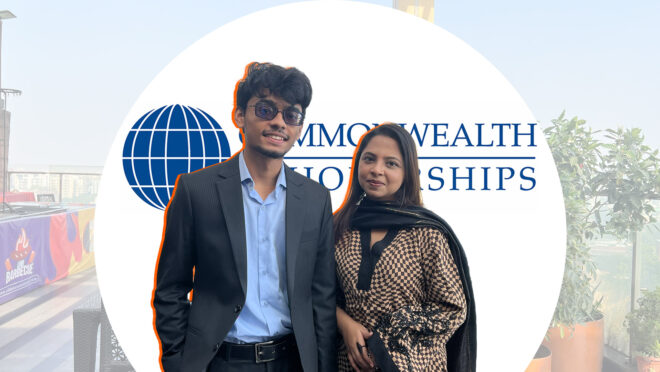
Many of us think that studying at a private or a public university decides who gets a scholarship to study abroad. Two siblings, one from a private university and the other from a public one, have proved that wrong.
Rifat Tasnim Anannya, a graduate of American International University-Bangladesh (AIUB), won the Commonwealth Shared Scholarship and earned an MSc in Cyber Security from the University of the West of England, Bristol (UWE Bristol). She is now an Assistant Professor at AIUB. A few years later, her younger brother, Shah Md. Sharup Hasan Anando, a University of Dhaka graduate, won the same scholarship for an MPhil at the University of Cambridge.
Two different universities, one scholarship, and both earned it through their own hard work.
I reached out to both of them to learn how their journeys unfolded, what their family means to them, and what they would tell students who want to try.
Growing up
At the centre of both their stories is family. They had parents who took education beyond textbooks. Their parents ensured that they grew up in an environment where singing, dancing, drawing and playing the guitar were encouraged.
Her father would take her to art competitions across Dhaka, while her mother waited for hours outside her dance and art classes.
Rifat considers her father her biggest academic inspiration. He won the Chancellor’s Gold Medal at the University of Dhaka. Years later, Rifat was nominated for a Chancellor’s Gold Medal during her MS at AIUB.
Rifat grew up in a home where her parents ensured a fine balance between academics and extracurricular activities.
As for Anando, we all know that a younger sibling’s childhood often revolves around their older siblings. Anando was no different. Most of his time was spent with his two sisters. “My mum used to say she had three daughters.”
He describes himself as never having been a bright student at school, only good enough to pass. Seeing his sister win the scholarship changed how he saw things. Anando said that seeing his sister do it made the whole thing feel real for him. Before that, he used to feel like Cambridge or a Commonwealth Scholarship was something that happened to other people.
About the scholarship
The Commonwealth Shared Scholarship is co-funded by the Commonwealth Scholarship Commission and UK universities. It is meant for talented students from developing Commonwealth countries. It is different from the common scheme, which goes through a nominating agency, the UGC in Bangladesh.
It is fully funded. It covers tuition, a return flight, a monthly living stipend, a warm clothing allowance, visa and medical costs, and smaller grants for thesis work and travel.
Rifat’s scholarship
Rifat did both her BSc and MSc in Computer Science at AIUB and joined the university as a lecturer.
The COVID-19 period changed a lot of our lives. Rifat was no different. During that time, Rifat was stuck at home. One day, an ad popped up on her Facebook feed. It was about the Commonwealth Shared Scholarship.
She filled out the application out of curiosity, with considerable doubts about her academic background. She was worried that a private university graduate might not be awarded such a well-recognised scholarship. But her doubts were proved wrong, and she was awarded the Commonwealth Shared Scholarship.
In her case, there was no interview. She answered essay questions about her studies and how she would help Bangladesh after returning. She believes her application stood out because her field matched the needs of Bangladesh.
She has also always wanted to inspire women to enter cyber security. She wanted to change the picture people have of a hacker, which is often “a young man in a black hoodie”. Finally, she got into UWE Bristol, which was the partner university for Cyber Security that year.
She applied around February or March and heard back in September. The application cost nothing. Her husband read her drafts, organised her papers, and studied beside her during her certifications.
Many people around her believed such scholarships were only for public university graduates. Rifat proved that wrong. At home, her win became an inspiration, and her younger brother, Anando, began preparing his own path.
Anando’s scholarship
Anando studied Genetic Engineering and Biotechnology at the University of Dhaka. According to Rifat, he graduated with a perfect 4.00 CGPA. He did his research on protein engineering, genome sequencing, and a dengue project.
The dengue project was where immunology caught his interest. In Bangladesh, infectious disease isn’t abstract. It rises every monsoon, and soon you see it fill up the hospitals.
Anando wanted to learn more about this, which is why his purpose for studying was clear. He wanted to work on a specific problem rather than a broad topic. He knew what, why, and where he wanted to study, but funding was important. Without funding, he could not have gone, so the scholarship and the admission were one plan from the start. With Rifat’s guidance, he started preparing for it.
It was Rifat who told him about the Shared Scholarship. She also let him use her Commonwealth statements as examples.
Rifat often told Anando one thing: “If I can get it, you can get it FOR SURE.”
And he ended up getting it.
His process was different from hers. He took IELTS in late November 2025 and applied in early December. His references came from people who had seen his lab work closely and from teachers who taught him several courses. He wrote his SOP and arranged his references in just one week.
Most of his work was for the Cambridge application, and Cambridge conducts interviews. His interview took place in the second week of January 2026.
It was mostly about his research: what he did, why he did it, and what went wrong. The offer came after that. The funding nomination followed in March. He had applied for internal funding options as well, but Cambridge nominated him for the Commonwealth Shared Scholarship rather than Gates Cambridge because they felt it suited him better.
As a Bangladeshi citizen, his Cambridge application fee was waived. Apart from IELTS, he barely paid anything.
Rifat was not surprised. Knowing her brother’s academic record, she was confident that Anando would be nominated. She felt immense pride knowing he would be in an environment where his intellect would flourish.
Anando read the email twice to make sure he was not misreading it, and then he told his loved ones first. “It kind of felt surreal,” he says. “It still does sometimes as I cycle through the streets of Cambridge.”
His mother now finds it easy to explain to relatives. She just says he got the same scholarship his sister had.
For the family
For Rifat, the whole journey feels like an emotional rollercoaster of profound pride and bittersweet goodbyes for a family that had never lived outside Bangladesh. Life has also come full circle for her. The mother who once waited outside her classes now cares for Rifat’s three-year-old son, so she can focus on her work.
Anando thinks of his parents and says everything they sacrificed, from the sleepless nights to the unimaginable pressure, actually led somewhere. He ends his answer with a simple line: “Thank you, Ammu and Abbu.”
Hearing from both of them, it was clear that their parents did something right. For many of us, having one Commonwealth scholar in the family feels surreal, but for Rifat and Anando’s family, it was their reality. Both credit every step of their journey: their parents’ efforts, childhood environment, sibling bond, the people around them and the Almighty’s blessings, along with their own hard work. They embrace it all.
Advice for students
According to Rifat, the public and private university divide does not matter to global scholarship committees. They simply look at your grades, your leadership, your community work, and your plans to give back.
Anando keeps it simple: “Nothing is that complicated.” Work hard, be honest, and apply. “Most people who don’t get these scholarships simply never applied.”
Both have plans for home. Rifat wants to research how cyberbullying affects mental health in Bangladesh. Anando wants to do a PhD and work on infection and immunity problems that matter for countries like Bangladesh, such as dengue. His supervisor, Prof. Sajib, says diseases like dengue are largely neglected in Western research. And both say the same thing at the end: never forget your roots.