COP31: Circular economy must put youth and workers first, speakers warn
COP31: Circular economy must put youth and workers first, speakers warn
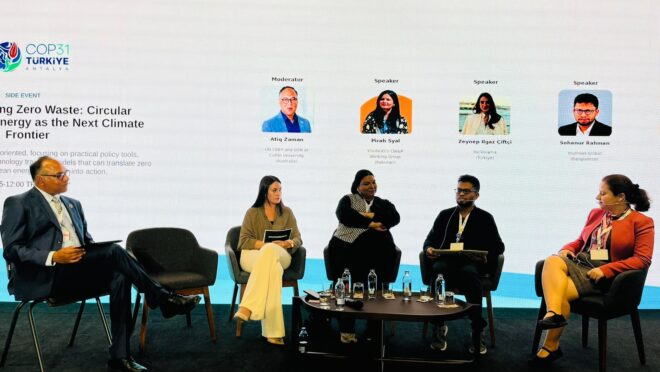
Speakers say zero-waste transition requires fair wages, safe working conditions, protection and recognition of waste pickers, meaningful youth participation and greater support for young entrepreneurs and SMEs.
A transition to a circular economy will remain incomplete unless waste workers and waste pickers receive fair wages, safe working conditions, social protection and a meaningful role in decision-making, while young people gain opportunities to lead innovation and shape the green economy, speakers warned at a COP31 side event in Antalya on Saturday.
They urged governments and businesses to ensure that zero-waste and resource-efficiency initiatives create decent livelihoods, protect informal workers and open economic opportunities for young entrepreneurs and small and medium-sized enterprises (SMEs).
The session, titled “Youth Powering Zero Waste: Circular Economy and Energy as the Next Climate Frontier”, was held at the Green Zone Main Stage of the Türkiye Pavilion from 11:15am to noon. Panellists from Bangladesh, Pakistan, Türkiye and Egypt discussed how young people, communities and businesses can advance zero-waste solutions and connect them with the clean-energy transition.
Moderator Dr Atiq Zaman, Associate Professor at Curtin University Sustainability Policy Institute and co-founder of Global South Nexus, said countries would struggle to meet their climate goals unless resource efficiency, waste reduction and circular production became integral parts of decarbonisation strategies.
“Zero waste and decarbonisation are not separate journeys; they are one,” he said, urging countries to make circularity-based green industrial transformation a national and global priority alongside renewable energy.
The session was organised by the UN Council of Engineers for the Energy Transition, Global South Nexus and Curtin University, in collaboration with COP31 Türkiye Brief and YouthNet Global.
Textile waste workers and waste pickers must not be left behind
Speaking from Bangladesh’s experience, Sohanur Rahman, Executive Coordinator of YouthNet Global, said a genuinely circular textile economy could not be built without placing workers at its centre.
Bangladesh’s ready-made garment sector employs about four million people and accounts for more than 80 per cent of the country’s merchandise export earnings. Yet the informal system that collects, sorts and processes textile offcuts, locally known as jhut, remains largely overlooked in discussions about the industry’s green transition.
Bangladesh generates an estimated 330,000 to 500,000 tonnes of pre-consumer textile waste annually. A 2026 study by Circle Economy and the Labour at Informal Economy Society estimated that 18,400 to 22,000 informal jhut facilities employ between 195,000 and 214,000 workers across 12 districts.
The workers reportedly put in eight to 10 hours a day, at least six days a week, for average monthly earnings of about Tk 6,000, according to the study.
Despite their contribution to recovering valuable materials for reuse and recycling, many workers in the informal textile waste sector remain outside formal labour protections and social security systems.
“A just transition is not simply about creating employment opportunities for workers. It is also about ensuring that workers have the power to shape the future of their own work,” Sohanur said.
He called for protective equipment, adequate ventilation, fire safety, sanitation, fair wages, healthcare, skills training and social protection for workers in the informal textile recycling chain.
He also stressed the need to recognise and protect waste pickers, who play an essential role in collecting and recovering recyclable materials but often work without adequate safety measures, legal recognition, decent incomes or access to social protection.
Governments, he said, should recognise waste picking as an important part of the circular economy, protect the livelihoods and rights of people engaged in the sector, and ensure their participation in waste-management planning and decision-making.
Formalisation, he said, must not displace existing workers, criminalise informal livelihoods or concentrate economic opportunities in the hands of large companies. Instead, it should recognise waste pickers and informal recycling workers as essential contributors to the circular economy, protect their livelihoods and ensure their participation in the formal economy.
He urged governments and businesses to ensure that waste pickers and informal recycling workers have access to safe working spaces, protective equipment, healthcare, fair compensation, social security and representation in decisions affecting their livelihoods.
He also called on international brands and buyers to share the costs of the green transition rather than passing them on to suppliers and workers. Climate finance and technology, he said, should reach small enterprises, cooperatives and worker-led initiatives.
“Can we call our textile industry sustainable if the people recovering its waste remain economically insecure and socially unprotected?” he asked.
Enabling young innovators and businesses
Selen İnal, Chairperson of the Sustainable Agriculture Cooperative and member of the UN Council of Engineers for the Energy Transition, said circular economy principles must be closely linked to clean energy and youth-led innovation.
“We are not here to tell young people what to do. They already have brilliant ideas, the passion to solve the world’s problems, and the energy to make change happen. Our responsibility is to build enabling ecosystems and remove the barriers that stand in their way,” she said.
Zeynep Ilgaz Çiftçi, founder of Türkiye-based Packorama, presented her venture’s biodegradable and plastic-free packaging solutions, which aim to reduce plastic waste and shift consumption patterns while creating jobs and supporting women’s entrepreneurship.
Her venture illustrates how youth-led businesses can translate circular economy principles into practical solutions while generating employment and creating opportunities for women entrepreneurs.
Panellists stressed that young entrepreneurs and SMEs need access to finance, technology, production facilities, skills, business networks and markets to scale their zero-waste innovations and compete with larger companies.
They called for targeted financial and technical support, affordable credit, access to markets and business development opportunities for youth-led enterprises and SMEs, enabling them to develop and scale circular economy solutions.
They said targeted investment and enabling policies are essential to ensure that the economic benefits of the green transition are not concentrated among large businesses.
Sawsan Elawady, founder and president of the Impact Foundation for Environmental Work in Egypt, shared how her organisation trains women to transform agricultural residues into useful products, reducing waste while creating livelihood opportunities.
She highlighted the importance of community participation, practical skills development, market access and partnerships in building locally driven circular economy solutions.
Pirah Siyal, Acting Contact Point for YOUNGO’s Chemicals, Waste and Pollution Working Group from Pakistan, said her country addresses single-use plastics through federal regulations and provincial restrictions rather than one nationwide law.
Citing estimates presented at the session, she said Pakistan uses about 55 billion plastic bags annually and generates roughly three million tonnes of plastic waste each year, of which about 4 per cent is recycled.
She clarified that the federal Single-use Plastics (Prohibition) Regulations 2023 apply to the Islamabad Capital Territory, while provinces have introduced their own measures.
Youth mobilise against lead pollution
Sohanur also highlighted YouthNet Global’s #SolveLeadPollution campaign, implemented with Pure Earth Bangladesh and UNICEF, which mobilised young people across all 64 districts to document pollution, raise awareness and advocate action against hazardous practices, including informal recycling of lead-acid batteries without adequate environmental and occupational safeguards.
He said environmentally sound battery recycling must become an integral part of the clean-energy transition as demand for batteries and energy storage increases. Without effective regulation, appropriate recycling infrastructure and worker protection, the growing battery economy could create new pollution risks.
Estimates cited at the session suggest that more than 36 million children in Bangladesh may have elevated blood-lead levels.
Sohanur called for stronger industrial standards, improved healthcare, blood-lead screening and greater youth participation in pollution prevention. He also stressed the importance of engaging men and boys in shared environmental and care responsibilities.
Speakers agreed that the success of a circular economy should not be measured only by the volume of waste recycled or emissions reduced. It must also be measured by whether workers and waste pickers are recognised as essential contributors, receive fair wages, legal recognition and safer working conditions, communities share the economic benefits, young entrepreneurs and SMEs have access to finance and opportunities, and young people have meaningful power to shape the transition.