A New York city school almost bought robots from an 'adult doll' manufacturer
A New York city school almost bought robots from an 'adult doll' manufacturer
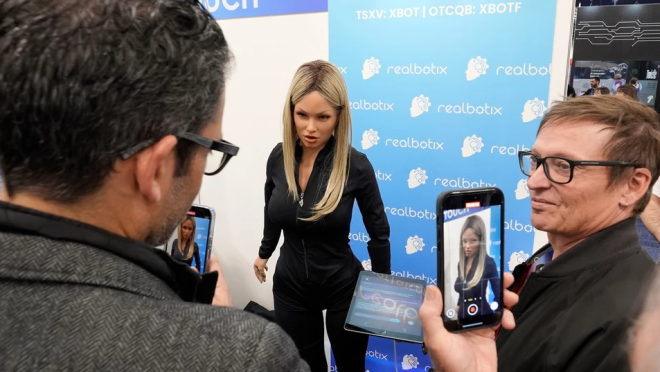
A school district in upstate New York has put on hold plans to introduce a humanoid, AI-powered robot in classrooms after education officials, teachers and residents raised concerns over student privacy and the robot maker’s ties to a company involved in producing highly realistic sex dolls.
The Salamanca City Central School District’s board had approved spending nearly $60,000 to purchase the robot from Realbotix. The stationary robot, nicknamed “Sally” because of its long dark hair, was intended to support high school students studying robotics and technology.
Superintendent Mark Beehler said Tuesday (28 July) the robot could help students learn programming, maintenance, software updates and troubleshooting.
However, news of the planned purchase sparked concern in the small community, which is located on the Seneca Nation of Indians reservation. Parents and teachers questioned how students’ personal information would be handled.
Teachers’ union leaders also criticized Realbotix’s connection to a sister company involved in producing sex dolls, although both the district and Realbotix said the two businesses operate independently.
“A robot built by a company associated with sex dolls has no business in our classrooms,” said Melinda Person, president of the New York State United Teachers union.
The pilot program remains suspended while the district works with state education officials on stronger student data privacy agreements and continues discussions with the community, according to a statement posted by the district on Facebook Friday.
New York Education Commissioner Betty Rosa said she remained concerned about the robot’s proposed classroom role after state officials met with district representatives.
Although the district had told state officials that the robot would not be used to provide classroom instruction, Rosa said a presentation to the school board described it as a “tutoring platform.”
She also raised concerns about student data privacy and security.
Teachers’ union officials questioned whether the project could eventually lead to replacing human educators. The robot is designed to move its arms and hands but does not have working legs.
“Our students don’t need robots,” Person said. “They need real relationships with caring adults.”
Beehler said the project was not intended to replace teachers or other school staff.
“There is no possible way a robot can replace a human in a school,” he said. “Even if it were possible, it would in no way be in the best interest of students. Teaching is a human-to-human process.”
The pilot would also include a virtual AI-powered teacher’s assistant and an at-home tutoring program.
Beehler, who was introduced to Realbotix through a former colleague, said the Las Vegas-based company was a suitable choice because its robots are already programmed with WozEd, an educational curriculum developed by Apple co-founder Steve Wozniak that the district already uses.
Last year, a charter school in San Diego introduced two AI-powered robots purchased from UK-based robotics company Engineered Arts for $500,000.
Salamanca school officials said “Sally” would not collect students’ personal information, record audio or video of interactions or send data to Realbotix.
The robot has also been programmed to avoid inappropriate subjects such as sex, violence and gambling. It will not be able to access the public internet or obtain responses from unverified generative AI services.
According to the district, all information used by “Sally” will be stored locally, and the life-sized robot will use roughly as much energy as a laptop.
Realbotix said Tuesday that student authentication would be handled through the district’s existing systems. Any information linked to students would remain encrypted and under the school district’s control, the company said.
The company also rejected suggestions that “Sally” was a modified sex doll, describing it as a newly manufactured, purpose-built educational robot with no altered hardware.
The robot was produced by Realbotix LLC, which focuses on healthcare, education and other nonadult commercial applications.
A sister company, Intima LLC, has an ownership stake in RealDoll, a longtime producer of sex dolls, including AI-powered models marketed as advanced sex robots.
Realbotix said the two companies have separate products and no crossover in their operations. They maintain separate management, employees, payroll, facilities, manufacturing operations, product development and marketing strategies, it said.
Beehler said isolated school districts such as Salamanca, located along the Allegheny River near the Pennsylvania border, need new ways to bring emerging technology into classrooms.
He said students in the area often have to travel one to two hours to access opportunities to experience new technologies.
One purpose of the robot, he said, was to help provide equal opportunities and encourage students to pursue careers in robotics, artificial intelligence and other STEAM-related fields.
Some residents, however, remain unconvinced.
Joplin Ficek, who graduated from Salamanca High School in 2024 and now works at a daycare, said she saw no reason for robots or AI to have such a prominent role at her former school.
“They just need to hire more people who are willing to put in the effort for the children,” Ficek said. “They need more interaction with the children than having some robot raise our kids.”