M. John Harrison wins Booker Prize 2026 with 'The End of Everything'
M. John Harrison wins Booker Prize 2026 with 'The End of Everything'
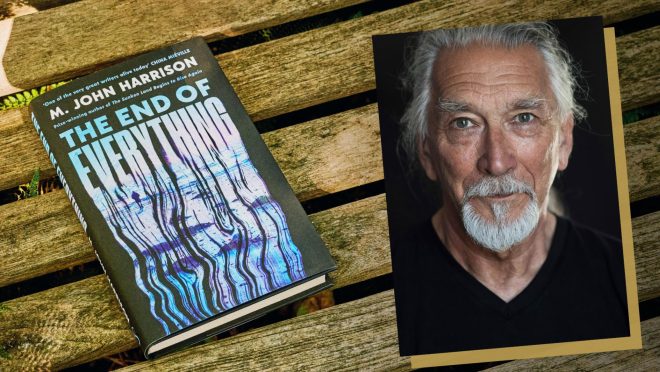
British author M. John Harrison won the 2026 Booker Prize for his novel The End of Everything following a unanimous decision by the judging panel.
Published by Serpent’s Tail, an imprint of Profile Books, the win marks the publisher’s first Booker Prize victory.
The judges described the novel as a “slyly satirical and unsettling post-apocalyptic adventure” that challenges readers’ understanding of the world while offering unexpected moments of warmth and optimism.
The judging panel was chaired by classicist and author Mary Beard, alongside Raymond Antrobus, Jarvis Cocker, Rebecca Liu and Patricia Lockwood.
“It’s a book that turns you upside down, raises a wry smile – and surprisingly, given the subject matter, leaves you with a twinge of optimism,” Beard said.
“Some try desperately to make sense of what has happened. But one main point of the book is that if, or when, such an apocalypse comes it will be incomprehensible. And the old rules won’t matter either… This is the politics of now seen through the lens of the future.”
The judges said the novel could be read as a thriller, mystery, satire, dystopia, road novel or work of realism, with each genre presented “at a slant and with a twist”.
They also praised Harrison’s use of overheard dialogue, describing it as a “high-level form of assemblage or decoupage that complements the makeshift nature of this unsettling universe”.
The panel highlighted the book’s “subtle, surreal, and sly” humour, saying that despite its bleak setting, “there still were moments we found ourselves laughing aloud.”
Set a few decades into the future along England’s south coast, The End of Everything takes place years after a mysterious catastrophe known as an invasion of “iGhetti”, with the letter “i” suggesting a digital connection.
In the aftermath, social norms have broken down and vigilantes enforce law and order. Crashed planes lie in residential gardens, while people attempt to maintain ordinary routines, including children’s parties and morning coffees at seaside cafes.
The story follows Phillip Tennent and his elderly aunt Marnie. Tennent works as a beachcomber along the English Channel, collecting objects washed ashore.
His routine changes when he finds an unusual blob of jelly that rapidly grows, develops speech and begins giving instructions to the people looking after it. Tennent must carry the changing object inland before it destroys everything he believes he knows.
Harrison has said the novel was initially inspired by the 2008 financial crisis. He wanted to explore what he described as “the failure of explanation in society”, using a disaster as the starting point.
He said the book examines “what happens when all of our expectations and explanations of the world become an ongoing disaster, but we still have to make a life?”
Discussing the characters, Harrison said: “They’re people acting out of desperation because they don’t know what the world is anymore… Your entire philosophy, your entire epistemology, is based on what you know. And suddenly you don’t know anything.”
The author also drew inspiration for the novel’s setting from art towns along Britain’s east coast.
The book received positive reviews from literary critics. Catherine Taylor of the Financial Times described it as “a formidable book: dusky, casually horrifying, unexpectedly compassionate”.
Taylor added that its ending invites readers “either to accept the end of everything as the title conveys, or imagine a continuous, ambiguous present”.
Helen Macdonald of The Observer wrote: “The world is falling apart and The End of Everything properly fucks one up.”
Simon Ings of The Telegraph said: “Harrison isn’t weirder than most other writers, just better. Reading The End of Everything, you feel you’re not so much reading as dreaming.”
The novel opens with a description of tideline scavengers living in temporary shelters made from whitened sticks and rags, which glow at night when seen from orbit.
In one scene, Tennent walks up from the salt wind carrying his discovery, wrapped in rags and about the size of a baby. Meeting another beachcomber, he says: “‘Eventually it’ll turn into speech,’ Tennent said, without knowing why. They both laughed.”