RCOY Asia-Pacific 2026 concludes with youth priorities set for COP31
RCOY Asia-Pacific 2026 concludes with youth priorities set for COP31
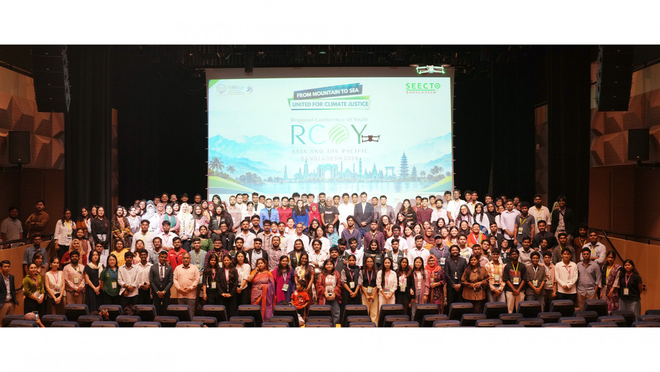
Regional Conference of Youth (RCOY) Asia-Pacific 2026 concluded at the CCDB Climate Centre in Gazipur on 6 October, with delegates jointly drafting a Regional Youth Statement and examining how climate commitments, finance, transition and solutions can translate into practice.
Co-organised by 12 youth-led organisations from across the Asia-Pacific region, the four-day conference’s sessions in Bangladesh were hosted by BRAC University’s Centre for Climate Change and Environmental Research (C3ER) and non-governmental organisation SEECTO Bangladesh.
Held in Bangladesh for the first time, the conference was recognised under YOUNGO, the official youth constituency of the United Nations Framework Convention on Climate Change (UNFCCC). Its motto was “From Mountains to Sea: United for Climate Justice”.
Described by the organisers as one of the region’s largest youth climate conferences, the event brought together more than 500 participants from 28 countries at BRAC University. Participants included young people, climate activists, researchers, development workers, policymakers and representatives of international and development organisations.
The programme featured panel discussions, workshops, COP-style simulations, networking opportunities, cultural activities and more than 50 exhibition and innovation stalls.
Sessions covered climate finance, youth leadership, employment, energy, environmental protection and the participation of women and marginalised communities.
The programme also provided simulation-based preparation for COP31, combining dialogue, negotiation, learning and practical experience.
Delegates jointly drafted a Regional Youth Statement to be taken forward to COY21 and COP31 in Antalya, Türkiye. COP31 is scheduled for 9–20 November.
Speaking as the chief guest, AKM Sohel, UN wing chief at the Economic Relations Division, highlighted the importance of young people’s participation in climate and development decisions.
“Every dollar we take a loan, the youth have to pay back in the future. If you have the stake in the dollar, you should have the voice. Every single utterance has to be based on evidence, data and science,” he said.
Miguel Mateos Muñoz, chief of communication and advocacy at Unicef Bangladesh, urged young delegates to look beyond those present at the conference.
“As you take the Regional Youth Statement to COP31, ask yourselves: whose voice is still missing? Bangladesh’s NDC 3.0 puts children and young people at the centre of climate action,” he said.
“Now comes the real test: implementation. As you step onto the global stage, carry with you the realities, demands and hopes of those who cannot be in the room, and make sure no child is invisible in the decisions shaping their future,” he added.
Dr Ainun Nishat, professor emeritus and adviser to C3ER, encouraged young people to build their capacity, understand policy processes and ground their work in evidence.
“Learn the language of policy. Youth advocacy needs to be evidence-based and data-driven,” he said.
Dr Saimum Parvez, special assistant to the prime minister on environment, forest and climate change, said Bangladesh could serve as a bridge for climate cooperation among South and Southeast Asian nations.
State Minister for Environment, Forest and Climate Change Sheikh Faridul Islam attended the inaugural ceremony as the chief guest. BRAC University Registrar Dr David Dowland delivered the welcome address, while C3ER Director Dr Md Golam Rabbani presented the keynote paper.
The conference further advanced BRAC University’s efforts towards the United Nations Sustainable Development Goals (SDGs), particularly SDG 4 on quality education, SDG 13 on climate action and SDG 17 on partnerships.