Revuelto SV: Lamborghini's most powerful production car yet
Revuelto SV: Lamborghini's most powerful production car yet
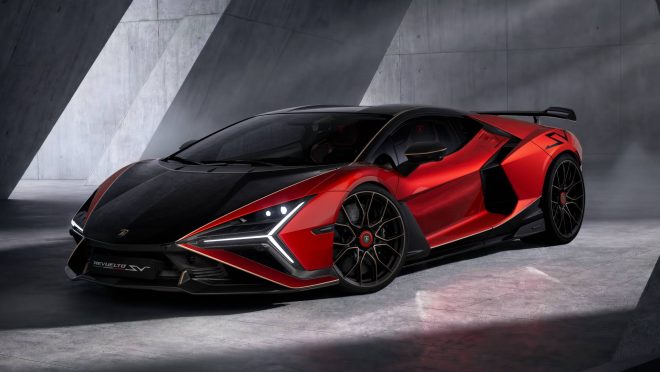
Three years after the standard Revuelto’s launch, Lamborghini has now unveiled its more extreme SV (Super Veloce) version.
It brings more power, less weight, improved chassis technology and, most importantly, a huge rear wing. Look at the SV, then go back to the regular Revuelto- it almost looks incomplete without the spoiler.
Beyond the rear wing
The colour scheme on this particular SV may be divisive, with more than a hint of Tron about it, but it is one of four exclusive launch liveries.
Other colours and designs are available, while customers can specify up to 25 exterior components in visible carbon finish, much like the Urus SE Performante.
The aggressive styling is not just cosmetic.
It generates 80% more downforce than the standard Revuelto and 10% more than the Aventador SVJ.
Much of that comes from the rear wing, while the front splitter and underbody have also been revised.
Cooling has been improved too, with a better seal around the front wheel wells to direct airflow towards the side coolers, plus a new cooling channel for the rear brakes.
New 3D-Superlight Dromos wheels also save weight and are centre-locked like those on a race car.
How powerful is the Revuelto SV?
The 6.5-litre naturally aspirated V12 remains, with only the exhaust tune changed. The extra power comes from the electric system. The three-motor setup remains—one motor between the engine and gearbox and one on each front wheel—but the battery grows from 3.8kWh to 7.3kWh.
Electric range is still not the priority. Instead, the electric system helps deliver a 214mph top speed, 0-62mph in 2.4 seconds and 0-124mph in 6.7 seconds, while retaining the V12 soundtrack.
More than just extra power
New hardware and software help manage the extra performance. Manually adjustable passive dampers replace the regular car’s adaptive setup. Lamborghini claims a 17 per cent improvement in agility and a 10 per cent increase in lateral grip.
More significant is the new Integrated Brake Control system and next-generation inertial sensor. Mounted near the vehicle’s centre of gravity, the 6D sensor uses real-time data to estimate speed, side-slip angle and the friction coefficient between the tyres and road. The system is similar to that used by sister company Ducati on its latest high-performance Panigale motorcycles.
According to Lamborghini, the system enables shorter stopping distances, better braking and cornering control, and greater stability over kerbs and jumps.
The brakes are huge, with standard CCM-R Plus carbon-ceramic discs measuring 420 x 40mm at the front and 410 x 32mm at the rear. Lamborghini claims 11 per cent better peak deceleration, 23 per cent greater heat dissipation and 12 per cent lower brake-disc temperatures.
That comes in handy for chasing a production-car lap record at the Hockenheimring. Fitted with Bridgestone Potenza R road-legal semi-slicks, the SV managed a 1:41.6 lap—less than three seconds behind a front-running DTM-spec GT3 race car.
Lamborghini has not revealed which driving mode was used for the record run. Alongside Strada, Sport and Corsa, the SV gets a new Pilota setting, activated through a dedicated steering-wheel rotary knob, which unlocks a five-stage traction-control mode.
Lamborghini has yet to confirm pricing, but expect a base figure well above £500,000, with orders opening in the final third of 2026.