Singapore gov introduces matchmaking for government officials amid falling birth rates
The service uses the Gale-Shapley Stable Marriage algorithm, a mathematical framework that matches two equally sized groups based on their preferences.
Singapore gov introduces matchmaking for government officials amid falling birth rates
The service uses the Gale-Shapley Stable Marriage algorithm, a mathematical framework that matches two equally sized groups based on their preferences.
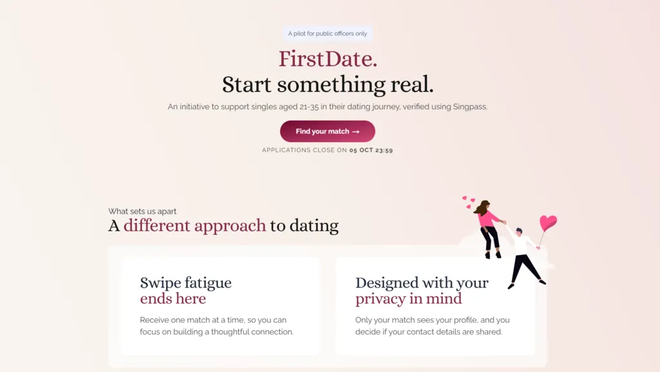
Singapore has launched a government-backed matchmaking service for public sector workers aged 21 to 35 as the city-state grapples with a record-low fertility rate.
The initiative, called FirstDate, was launched this week and uses the Nobel-winning Gale-Shapley algorithm to match participants based on their interests, habits and values, the BBC reported.
Rather than allowing users to browse through multiple profiles, FirstDate matches participants with one potential partner at a time. Its website describes the service as offering “a different approach to dating” and promises that “Swipe fatigue ends here”.
Participants sign in using Singapore’s national digital identity system before completing a survey about their interests, habits and values.
FirstDate’s launch has drawn mixed reactions, with some Singaporeans describing the initiative as “dystopian”, while others said they would be willing to try it.
The service uses the Gale-Shapley Stable Marriage algorithm, a mathematical framework that matches two equally sized groups based on their preferences.
The late mathematician Lloyd Shapley received the 2012 Nobel Memorial Prize in Economic Sciences for his work on the algorithm. It has been used in areas including public school admissions, medical residency matching and dating services.
Elizabeth, a 29-year-old employee of Singapore’s Defence Ministry who is interested in trying FirstDate, told the BBC, “At the end of the day, I think the experience of meeting someone through an application doesn’t change much across the [different types of] applications.”
“But it is nice to know that the likelihood of being scammed is much lower. We’re all public servants looking for a partner, right?” she added.
The initiative has also faced criticism from social media users who say restricting it to government workers discriminates against those outside the public sector.
Others have questioned the 21-to-35 age limit.
“They are only doing this to raise the total fertility rate. They don’t actually [care] about whether we find a partner otherwise.
“Since there are higher risks involved in having kids at 35 and older, the government just writes [the older singles] off,” a Reddit user wrote.
FirstDate is currently being run as a pilot programme, and it remains unclear whether the service will eventually be opened to the wider public.
The launch comes as Singapore faces mounting demographic pressures. Fewer than 30,000 babies were born in the country in 2025, the first time the figure has fallen below that level in six decades.
Deaths, meanwhile, have continued to rise in the ageing city-state, reaching about 26,500 in 2025.
In August, Prime Minister Lawrence Wong announced measures to support families and encourage couples to have children, including almost S$70,000 ($54,000; £41,000) in financial support for each child by the age of 17.
FirstDate is not Singapore’s first attempt to encourage relationships among its citizens.
In 1984, the government established the Social Development Unit (SDU), which organised social events aimed at helping single university graduates meet potential partners.
The initiative was criticised for being elitist because it targeted graduates. Authorities defended the approach at the time, saying non-graduates did not appear to have difficulty finding partners. The SDU was eventually phased out.
The following year, the government established another agency to promote marriage among non-graduates.
Singapore is also not the only government to experiment with matchmaking as it seeks to address declining birth rates.
In September 2024, Tokyo’s metropolitan government launched an AI-powered dating app for single residents as part of efforts to tackle Japan’s declining birth rate.
The app resulted in 265 couples getting married, according to government data released in July this year.