The 1940s experiment that tried to create a ‘super-dog’
The 1940s experiment that tried to create a ‘super-dog’
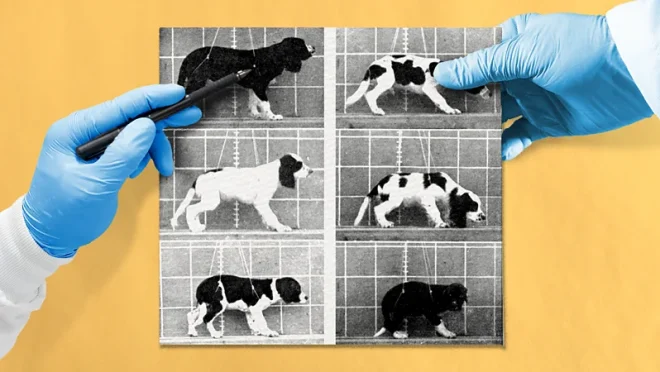
In post-war America, scientists embarked on an unusually ambitious mission: raise hundreds of puppies from birth, study almost everything about them and determine whether selective breeding could produce a canine genius.
The experiment, conducted at a sprawling research facility in Maine, ran for more than a decade and involved more than 500 puppies from five breeds — cocker spaniels, beagles, Shetland sheepdogs, basenjis and wire-haired fox terriers.
Researchers tracked the animals almost obsessively. They recorded everything from a puppy’s first startle response and first attempt at eating solid food to its first play fight and tail wag. From around five weeks old, the puppies were subjected to tests measuring intelligence, dominance, emotional responses and trainability.
The researchers had a long list of questions. Were some breeds naturally smarter? Did breeds have distinct personalities? How much did a puppy’s upbringing matter? And, perhaps most ambitiously, could humans breed a “super-dog”?
The answer to the last question was a fairly emphatic no.
The School for Dogs
The project emerged during America’s post-Second World War scientific boom, when researchers had access to unprecedented amounts of funding.
The so-called School for Dogs received $632,000 in funding — equivalent to nearly $9 million today — from the Rockefeller Foundation.
The project also had an ideological backdrop. Eugenics, the belief that selective breeding could produce genetically superior humans, had been badly discredited following its association with Nazi atrocities and growing international emphasis on human rights.
Yet some prominent academics continued to believe that genetics played a dominant role in human behaviour.
One of them was Alan Gregg, then director of the Rockefeller Foundation’s Division of Medical Science. Gregg believed undesirable behaviour, including criminality and mental illness, could be linked to genetics.
He wondered whether dogs could provide a way to demonstrate the power of heredity.
Dogs seemed particularly useful as research subjects because of the enormous differences between breeds. A Great Dane and a Pomeranian look radically different despite belonging to the same species, leading researchers to wonder whether those genetic differences might also produce major differences in intelligence and personality.
Physiologist John Fuller and animal behaviour geneticist John Paul Scott took on the project.
But their findings did not exactly support the theory their funders were hoping to prove.
No breed was the ‘super-dog’
The researchers put the dogs through a battery of intelligence and learning tests, including mazes in which they had to find food and repeated tasks designed to measure how quickly they learned.
Some breeds performed better than others on individual tests. But no breed consistently outperformed the others across the board.
The researchers ultimately concluded that no breed could be considered inherently more intelligent than another.
There were differences in temperament. Fox terriers, for example, showed greater tendencies towards aggression, which researchers linked partly to their history as hunting dogs.
But even those characteristics depended heavily on circumstances.
“The same breed might be fearful in one situation and confident in another,” Scott and Fuller wrote.
Basenjis, for example, were wary of unfamiliar situations but showed little fear around other dogs.
Rather than proving that selective breeding could create superior animals, the experiment ended up undermining the idea.
Scott and Fuller argued that in a social species, different traits can all have value. Boldness may help one animal confront danger, while caution in another may help alert the group to a threat.
Their conclusion was striking: the ideal individual does not contain every desirable trait. A successful society depends on different individuals bringing different strengths.
What puppies taught scientists about attachment
As the project progressed, Scott and Fuller became increasingly interested in another question: how much does early experience shape an animal’s personality?
They began investigating what happened when puppies were deprived of normal social contact.
In experiments that would be considered unacceptable today, some puppies were raised in isolation in large outdoor enclosures. High fences prevented them from seeing humans or other dogs, while food and water were delivered without direct contact.
By varying how long the puppies remained isolated, researchers identified what appeared to be a critical period for social development, roughly between four and 12 weeks of age.
Puppies exposed to people or other dogs during that period could generally be socialised normally. Those deprived of contact for too long became extremely difficult to socialise.
Without human contact, Scott later recalled, puppies could become “just like little wild animals” by around 14 or 15 weeks.
The findings helped establish the importance of early socialisation in dogs and would influence the way researchers understood canine development.
The end of the experiment
By around 1958, the School for Dogs was winding down.
The Rockefeller Foundation declined to continue funding after it became clear that the project was not going to produce the genetically superior dog it had originally envisioned.
The dogs were eventually distributed among laboratories in the US and Europe.
Despite its failure to create a “super-dog”, the project left a major mark on the emerging field of canine science.
Researchers today credit Scott and Fuller with helping establish dogs as serious subjects for the study of behaviour and cognition.
But some of their methods have not aged well.
The puppies raised in isolation were ultimately euthanised, and modern researchers would consider such experiments unnecessarily cruel.
Clive Wynne, director of the Canine Science Collaboratory at Arizona State University, said the scale of the original project is unlikely to be repeated.
“Nowadays, if you’re going to study people’s dogs, you better not do anything to their dog that you wouldn’t do to their child,” he said.
Modern researchers instead tend to work with people’s pets rather than breeding and housing hundreds of animals themselves.
At Duke University, for example, researchers have studied puppies to determine whether early traits can predict their suitability as guide dogs. That work has identified characteristics such as self-control, memory and the ability to read social cues as important indicators.
But one conclusion from the old School for Dogs experiment has endured.
There is no single breed that can definitively be called the smartest.
More than 70 years later, that finding still holds up.