Alok Nibash: A home for underprivileged cancer patients of Bangladesh
Alok Nibash: A home for underprivileged cancer patients of Bangladesh
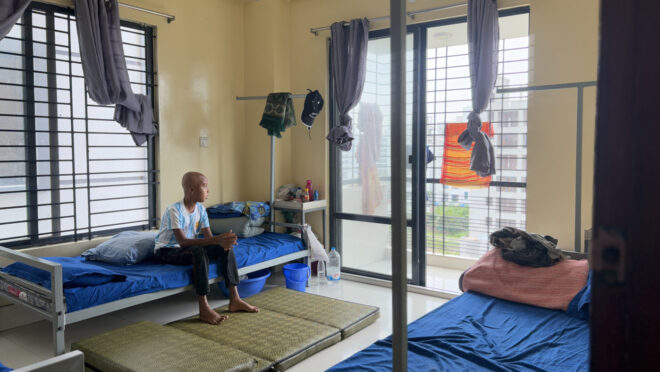
After founding a non-profit, cancer-survivor Albab realised that patients needed more than financial support: they needed a homely place to stay and hygienic meals. This inspired him to establish Alok Nibash, a shelter that 85 patients now call home.
As Nazmus Ahmed Albab reached the peak of his success as a garment entrepreneur, he was diagnosed with blood cancer in 2009. Knowing death was the only destination, he prepared himself for the inevitable.
Yet, whenever he thought about death, the faces of his family members would flash before his eyes. What would happen to them after he is gone? He desperately wanted to live. Not so much for himself, but more for his family.
He spent the next two years undergoing treatment in Singapore. Miraculously, Albab survived. He returned to Bangladesh in 2011, fully recovered. Yet, he struggled to adjust to his old way of life. Memories of the days when he had come face to face with death kept returning to him.

Infograph: TBS
One question, in particular, continued to haunt him: How do cancer patients who cannot afford to travel to Singapore for treatment manage to survive? How do the poor and helpless fight a battle against cancer?
Determined to find answers, he explored cancer treatment in Bangladesh, spending entire days in public hospitals. There, he saw how patients unable to afford better facilities were forced to endure treatment while staying in unhygienic, overcrowded corridors.
“Before cancer, I too was somewhat driven by the desire for a more comfortable lifestyle. My mind was constantly occupied with business. But cancer showed me what life is really about,” he said.
Seeing helpless patients lying in hospital corridors, surrounded by mosquitoes and flies, brought back Albab’s own suffering. He would often break down, wondering why Allah had given him a second chance and access to advanced treatment when so many others were denied it.
Grateful, Albab decided to dedicate himself to helping others. In 2013, despite 12 years in the garment industry, he left the business and began raising funds from his home, with help from acquaintances, to support cancer patients who could not afford treatment.
In 2015, he founded the Bangladesh Cancer Aid Foundation, bringing together friends, acquaintances and people whose lives had been touched by cancer in one way or another. Gradually, the foundation began receiving donations of around Tk10–12 lakh a month.
The funds were then distributed among patients referred by various hospitals. What began with just one patient in the first month gradually grew to 30 patients. Eventually, even doctors began to recognise Albab.
When financial aid was no longer enough
Despite years of fundraising, Albab felt something was missing. Patients still struggled with unhygienic hospital conditions and lacked even a decent place to rest.
Some patients would receive financial assistance and then return to their villages. Besides, there was no way to ensure whether they were actually receiving the necessary treatment.
Albab realised that patients needed more than financial support: a clean, hygienic place to stay and access to proper meals. Those travelling to Dhaka for treatment needed a shelter where they could rest after hospital visits and stay as long as necessary.
In 2019, the Bangladesh Cancer Aid Foundation was transformed into the Bangladesh Cancer Aid Trust (BANCAT). With an office in a rented house in Gulshan, volunteers who had previously contributed in their spare time could now take on full-time roles and become more actively involved.
“I brought together people whose loved ones had been affected by cancer, so we had a shared mindset. One day, over coffee, I met Rokeya Afzal Rahman, whom I already knew. I shared my vision and asked her to simply be our guiding light. She agreed and remained so until her death. Everyone who has joined us since has shared the same mindset,” Albab recalled.

Nazmus Ahmed Albab spent two years undergoing cancer treatment in Singapore. Photo: Courtesy
Cancer is not just a physical battle but also a psychological and social struggle. To support underprivileged patients and their families through this difficult journey, BANCAT launched Mosabbir Alok Nibash in 2019 in a single-storey house in Bashundhara.
Why the name Mosabbir? In the early days of Alok Nibash, Nazmus Ahmed Albab once organised an event featuring A R Kibria. Albab was not at all prepared for the event. Yet, a video of the programme uploaded to YouTube received a considerable number of views and was widely shared.
“After watching that video, a gentleman began following my work for nearly six months. Eventually, he called me and said, ‘I want to hand over my organisation to you. I also want to entrust you with the money in my bank account,'” Albab recalled.
The gentleman was Bir Protik Lieutenant Colonel Modassir Hossain Khan. Mosabbir, his 14-year-old son, had died of cancer, and he had long wanted to do something for cancer patients himself. Realising that his aspirations aligned with Albab’s vision, he handed over his entire organisation to BANCAT.
Later, Alok Nibash was named after his son. The facility is now located in Block A, Road 3, Bashundhara Residential Area.
A shelter built on care and compassion
Fundraising for Alok Nibash began in 2020, while its services officially commenced in 2021. Initially, the facility had 24 beds and a team of 12 staff members, including nurses, ward attendants, kitchen assistants, a driver and cleaning personnel. It also had one ambulance.
Later, another building was rented nearby in Bashundhara Residential Area to establish Alok Nibash-2. Together, the two facilities offer 85 beds for patients and accommodate an equal number of attendants, bringing their total capacity to 170 residents.
The organisation currently employs 47 people, including six kitchen staff, nine nurses and caregivers, four drivers, four cleaners, four ward attendants and one supervisor, among others. Working in rotating eight-hour shifts, they ensure round-the-clock assistance, responding to emergencies at any time of day or night.
The kitchens prepare around 600 meals daily for approximately 200 people at each meal, with food tailored to patients’ cancer types and individual needs. Residents can also cook for themselves.
“Before cancer, I too was somewhat driven by the desire for a more comfortable lifestyle. My mind was constantly occupied with business. But cancer showed me what life is really about.”
Nazmus Ahmed Albab, Founder, Bangladesh Cancer Aid Trust
A psychologist and a nutritionist visit twice a week. The nutritionist prepares personalised meal plans based on patients’ prescriptions and needs, while the psychologist counsels patients and their attendants.
At Alok Nibash-2, each floor is designated for a particular group of residents. One floor is reserved for children, another for women and another for men. There is also a separate floor for prayers and another dedicated to dining.
Patients at Alok Nibash generally spend their days at the hospital from 6am to 3pm. Syed Nasiruddin Tarek, BANCAT’s Human Resources manager, explained the strict hygiene protocols followed at the facility.
“When patients return from the hospital, we disinfect them, send them for a bath and then serve them food. We strictly enforce hygiene rules and encourage attendants to help with small cleaning tasks to build awareness about cleanliness. This is one reason we can keep the facility so clean,” he said.
Diagnosed with stage-four ovarian cancer three years ago, Parvin Akhtar has been staying here for the past year. Whenever she needs to visit the hospital for treatment or chemotherapy, her daughter accompanies her.
Her daughter, Saira Banu (real name withheld), is currently in the third year of her undergraduate studies.
“My mother is much happier here, and her condition has improved considerably. The place is clean, everyone is caring, and we feel at home. We could never have found this level of comfort and peace at a relative’s house in Dhaka. Best of all, we can stay as long as necessary,” she said.

BANCAT also runs a project called Alok Katha, through which people battling cancer use discarded pieces of fabric during their leisure time to create various handmade products. Photo: Courtesy
Most patients learn about Alok Nibash from their doctors. Others hear about it from fellow patients while undergoing treatment. Some even find it through a Google search.
Initially, Chief Patient Coordinator Rebeca Akhtar visited hospitals to introduce doctors and patients to the facility. Today, doctors themselves refer patients to Alok Nibash and provide its address. The number of patients occasionally exceeds the 85-bed capacity.
“We try not to turn anyone away. Even when we have more patients than our capacity allows, we usually manage to make arrangements. That’s because new patients are admitted every day, while others leave after completing their treatment,” said Nasiruddin Tarek.
Managing such a large number of people, however, is not always easy. Tarek acknowledges that conflicts sometimes arise among residents but they try to resolve them by encouraging mutual understanding and cooperation.
“We consider their psychological and social circumstances. Despite occasional conflicts, they share a remarkable bond as fellow fighters on the same journey,” he said.
Albab believes Alok Nibash’s greatest achievement is its cleanliness, nutritious meals and disciplined lifestyle.
“While we treat everyone with warmth and compassion, we are strict about following the rules. I remind our employees that their salaries come from public donations, not profits, so they must serve others with dedication,” he said.
Patients are not charged for accommodation or meals, however, according to Albab, they are not exactly providing these services for free.
“You could say we simply don’t charge the patients. We now have more than 200 donors, whose contributions help us pay our employees’ salaries and cover our operating expenses,” he explained.
Building an entire support system
BANCAT is currently developing Alok Bosti, a cancer village model in Manikganj. The five-bigha plot of land for the project was purchased using the donation made by Lieutenant Colonel Modassir Hossain Khan. Alongside a 120-bed residential facility, Alok Bosti will also have a clinic.
The initiative aims to bring healthcare services closer to patients living outside Dhaka, reducing their dependence on the capital for treatment.
“I want this to become a model that inspires every district in Bangladesh to establish at least one Alok Bosti of its own,” said Albab.
BANCAT also runs a project called Alok Kantha. During their leisure time, people battling cancer use discarded pieces of fabric to create various handmade products. Through sewing these quilts and other items, they can find a little warmth, comfort and solace.
The products include prayer mats, quilts and diaries, among others. The initiative aims to provide these individuals with a fixed amount of remuneration for their work and subsequently sell the products. Alok Kantha products are currently available in limited quantities at Unimart.
BANCAT has also begun working, on a modest scale, to rehabilitate cancer survivors and patients so that even those who have been financially devastated by the disease can rebuild their livelihoods and start earning again.
Building Alok Nibash and Alok Bosti — from a 25-bed facility in 2021 to today’s combined capacity of more than 200 beds — has not been without personal struggles for Albab. Yet, he said, he never allowed those challenges to draw an end to his work.
“I cried a lot for seven years. I reflected on life and came to understand myself. I had a roof over my head and food on the table. Even if there was no pulao or korma, I never went hungry. And above all, I had faith in myself and in Allah,” he said.
“My children were still studying when I took this initiative. If I could do this in middle age, why can’t young people? With courage, self-confidence and sound judgement, you can accomplish something meaningful,” he added.