Carnival of Change 2026: Building tomorrow, one community at a time
Carnival of Change 2026: Building tomorrow, one community at a time
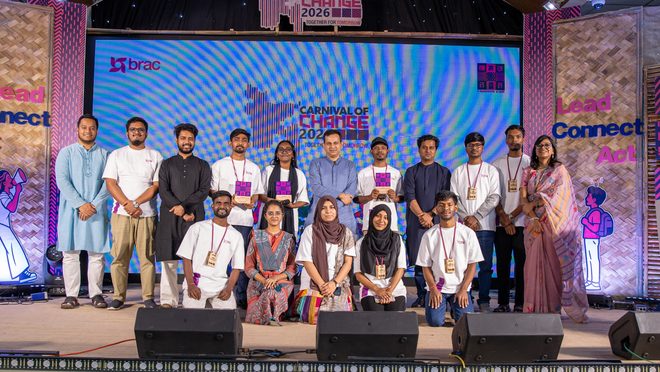
There are events that bring people together for a few days, and then there are events that leave you with something to think about long after they end or, in a broader sense, make you stand on your own feet.
BRAC’s Carnival of Change 2026: Together for Tomorrow represented the latter, which it successfully did over two days of the carnival.
Held on 28-29 November 2026 at BRAC CDM in Savar, the two-day event brought together more than 270 young changemakers from different parts of Bangladesh, alongside development professionals, entrepreneurs, academics, artists, and people working across different sectors.
Organised under BRAC Youth Platform’s Amra Notun Network (ANN), the carnival created a space for young people to showcase their initiatives, exchange experiences, engage in conversations, and explore how collective action can contribute to meaningful social change. It was an effort to value their entrepreneurial spirit.
With the theme Together for Tomorrow, the event was not simply about celebrating young people and their achievements. It was also about recognising their role in addressing present-day challenges and creating opportunities for collaboration across generations.
Building a community
One of the central conversations of the first day revolved around the difference between having a network and building an actual community.
In his address, BRAC Executive Director Asif Saleh said that, “Simply being connected through a network is not enough. A meaningful community is one where people stand beside one another, particularly during difficult times.” Drawing from his own experiences and working with the founder of BRAC, Sir Fazle Hasan Abed, he spoke about the importance of trust, mutual support, accountability, and maintaining relationships even with people who hold different opinions.
He also encouraged young participants not to look down on others when they fail, but rather to help them find the courage to begin again. His message was particularly relevant to a gathering of young people who are trying to navigate social challenges while building initiatives of their own.
What stood out was that BRAC could provide the necessary training, experience, mentorship, and platforms, but the real driving force behind change has to be the young people themselves. He encouraged participants from different districts to connect with one another and turn individual efforts into collective action.
This idea resonated with the broader purpose of ANN, those who move beyond individual achievements towards a community built on shared responsibility.
Perhaps the most engaging part of the carnival was the exhibition featuring 30 community-led initiatives developed by young changemakers associated with ANN.
The exhibition offered a glimpse into how young people are responding to challenges within their own communities. Rather than presenting social problems as distant issues, the participants demonstrated how locally grounded ideas could be transformed into practical products, services, and solutions.
The initiatives covered a wide range of social and environmental concerns, from cultural preservation and responsible medicine use to waste management, women’s economic participation, sustainable products, and children’s well-being.
The experience zones had added another dimension to the exhibition through interactive demonstrations, games, and workshops. Visitors could engage directly with the ideas and creative processes behind different projects, making the experience more participatory than a conventional exhibition.
The Amra Notun Young Changemakers Award 2026 was another significant part of the programme. Ten community projects were shortlisted for their innovative approaches to addressing social and environmental challenges. Among them, three initiatives received recognition for their creativity, potential impact, and contribution to local communities.
The recognised initiatives included Tea Community Culture Preservation, an effort to document and preserve the language, folklore, songs, festivals, traditions, and cultural heritage of tea garden communities; Project Kanan, an initiative promoting responsible medicine use and raising awareness about self-medication and antimicrobial resistance; and Shunno, a project transforming sugarcane waste into environmentally friendly, biodegradable products while creating livelihood opportunities for marginalised communities.
The award recipients were also offered the opportunity to receive BRAC’s Social Entrepreneurs Fellowship, which can help them strengthen their initiatives and expand their impact.
Beyond the awards, the exhibition demonstrated something important: meaningful innovation does not necessarily begin with sophisticated technology or substantial resources. Sometimes, it begins with understanding a problem that exists within one’s own community and having the determination to address it.
Conversations that went beyond the stage
The first day also featured several discussions and sessions designed to help young people reflect on leadership, entrepreneurship, and personal development.
Safi Rahman Khan, Senior Director of BRAC’s Education, Skills Development and Migration Programme, discussed the role of ANN in developing socially responsible young entrepreneurs and changemakers. He highlighted the network’s growth and its ambition to expand its alumni community further.
Yashna Chowdhury, Head of Enterprise Incubation and Advisory Services at BRAC’s Microfinance Programme, led a session on investing in youth-led enterprises. The discussion explored how mentorship, investment, market access, and strategic guidance can help transform promising ideas into sustainable social enterprises.
An alumni impact talk by Bithi Akter, from the Barishal Cohort 2024, offered a more personal perspective on navigating challenges, pursuing aspirations, and contributing to one’s community.
Another important segment presented the journey and future direction of ANN. Through a presentation by Shariful Islam Hasan, Associate Director of BRAC’s Migration Programme and Youth Platform, participants learned about the network’s development since its establishment in 2018, its achievements, and its growing community of changemakers. A thematic audiovisual presentation also captured the platform’s journey, values, and aspirations.
The day further included a performance by BRAC’s Popular Theatre team, featuring theatre and puppet shows that brought social issues closer to the audience through creative storytelling.
And, of course, the first day did not conclude without music. The cultural evening featured performances by ANN alumni artists, Miftah Zaman, and the much-anticipated performance by the popular Bangladeshi band Shironamhin. The musical performances brought a different energy to the gathering, giving participants an opportunity to connect beyond discussions, presentations, and formal sessions.
If the first day focused largely on showcasing initiatives and celebrating achievements, the second day placed greater emphasis on dialogue, reflection, personal experiences, and learning from others.
The day began with a mental well-being check-in and a yoga session facilitated by yoga instructor Faria Khan. It offered participants an opportunity to slow down, reconnect with themselves, and begin the day with mindfulness.
One of the major sessions was the intergenerational panel discussion titled Bridging Generations for a Better Tomorrow, moderated by Shariful Islam Hasan.
The discussion explored how culture, values, social movements, and civic responsibility shape society. More importantly, it addressed the need for meaningful youth participation in decision-making processes that affect their present and future.
There was another conversation on Career Compass: What Comes After ‘What Do You Want to Be?’, featuring Ahmed Rashid Joy, Deputy Managing Director and Chief Risk Officer of BRAC Bank. The session explored career aspirations beyond conventional job titles and professional identities, discussing adaptability, continuous learning, technological changes, artificial intelligence, and the importance of aligning professional choices with personal interests and values.
Another session, The Power of Financial Choices, led by Abdul Kadir, Programme Manager at BRAC’s Migration Programme and Youth Platform, introduced participants to the importance of informed and responsible financial decision-making.
One particularly interesting format was Amra Notun Adda, organised through a Human Library approach. Here, alumni professionals from different sectors shared their personal and professional experiences in smaller discussion groups. Instead of learning exclusively through formal presentations, participants had the opportunity to engage directly with people, ask questions, exchange perspectives, and learn from real-life journeys.
The afternoon featured a fireside conversation titled The Courage to Choose a Road Not on the Map, moderated by Deepti Chowdhury. The session brought together filmmaker Tanim Noor, cartoonist Mehedi Haque, journalist Zaima Islam, and Iftekhar Sayem, an alumnus of Amra Notun Network’s Chattogram Cohort 2022.
Their conversations explored what it means to move beyond conventional expectations, make unconventional professional choices, and create an identity on one’s own terms. Through their individual experiences, they highlighted the importance of creativity, courage, personal values, and remaining open to uncertainty.
The session offered a different perspective on success, reminding participants that there is no single prescribed route to building a meaningful life or career. The carnival’s final signature session, Impact Talk: Stories of Resilience, brought together three speakers whose personal journeys reflected empathy, determination, and the ability to overcome adversity.
Kishor Kumar Das, founder of Bidya Nondo Foundation, spoke about the Power of Empathy and how understanding the experiences of others can encourage collective action and meaningful social change.
Nishat Majumder, the first Bangladeshi woman to summit Mount Everest, shared her journey in Beyond the Summit: The Courage to Dream and Dare. Her story highlighted the importance of setting ambitious goals, remaining determined through difficult circumstances, and recognising the people who support us along the way.
Mohammad Junaed, a lecturer in the Department of Mechanical Engineering at Shahjalal University of Science and Technology, delivered The Strength against Odds, reflecting on resilience, determination, and the experiences that shape an individual’s journey.
Together, these stories offered something beyond conventional motivational speeches. They reminded the audience that resilience is not simply about overcoming obstacles independently; it is also about empathy, support, and the people who help us keep moving forward.
Beyond two days: What the carnival represents
Since its establishment in 2018, ANN has grown into a youth platform operating across 25 districts of Bangladesh. It has engaged more than 2,932 young people, while its alumni have collectively led over 475 community projects.
These figures reflect the scale of the network, but the more significant story lies in the initiatives and relationships behind them. Each project represents an attempt to understand a local challenge, mobilise people, and find a solution that responds to the needs of a particular community. What made Carnival of Change 2026 meaningful was the combination of these different experiences.
The event also reinforced an important distinction: young people should not be viewed merely as future leaders waiting for their turn. They are already contributing to society, identifying problems, developing solutions, and taking responsibility for the communities they belong to.
Ultimately, Together for Tomorrow was more than a theme for the carnival. It reflected the idea that meaningful social change cannot be achieved by individuals or institutions working in isolation. It requires trust, collaboration, intergenerational understanding, and the willingness to support ideas that may begin on a very small scale.
As the two-day gathering at BRAC CDM came to an end, it left behind a reminder that the future is not something we simply wait for. It is something we collectively build, through the choices we make, the communities we strengthen, and the changes we choose to pursue today.