The names we leave behind
As Dhaka approaches its 416 year anniversary, I want to contribute my love and appreciation for this city which, on one hand, is the most unlivable place on earth, and on the other, a place where history is as vibrant as any other metropolis that occupies the subcontinent.
The names we leave behind
As Dhaka approaches its 416 year anniversary, I want to contribute my love and appreciation for this city which, on one hand, is the most unlivable place on earth, and on the other, a place where history is as vibrant as any other metropolis that occupies the subcontinent.
I was sitting in a 73-year-old cafe on a corner of Bangla Bazar, crumb chaap and cutlet in front of me at “New Cafe Corner”, a place with history written on its wall. While I sipped my tea, I overheard a father and son in front of me. The father was asking the son where he wanted to go next: the riverbank or Victoria Park.
I put my cup down. The name is not Victoria Park; it has been almost seventy years. It is Bahadur Shah Park now; it has been since 1957, and yet here it was, still slipping off an old man’s tongue like the name never left.
That is the thing about Old Dhaka. It does not really let go of anything. It just piles the old name under the new one and lets you dig if you care to. So I sat there with my tea going lukewarm and the British snacks on my plate, and I let myself dig.
Anta, the ball, the house
Before it was Victoria Park, before the queen, before the hangings, this patch of ground in Sadarghat had a much smaller, much stranger name. Antaghar. It comes from ‘anta’, the local word for a billiard ball, and ‘ghar’, house.
The Armenians of Dhaka, a merchant community that once numbered in the hundreds and ran much of the city’s trade in jute, betel nut, and salt, built the subcontinent’s first European-style club right here at the end of the eighteenth century.
They called it the Armenian Club, but nobody in the neighbourhood bothered with that. To the locals it was just Antaghar, the house where the foreigners knocked ivory balls around a table on Sunday afternoons, up to a hundred and fifty of them at a time; natives were strictly not admitted.
What the trees saw
Then 1857 happened.
The Sepoy Mutiny, or the First War of Independence, depending on which history you were raised on, tore through the subcontinent that year, and Dhaka did not stay untouched. On the twenty-second of November, 1857, sepoys who had risen against the East India Company were defeated here. Eleven of them, one a woman, were hanged from the trees of Antaghar Maidan.
Their bodies were left up for days, swinging over the same ground where a billiard game had once been the worst thing anyone worried about. It was not an accident of geography. It was a message, delivered in the oldest colonial dialect there is, the public body as a warning.
I think about those trees more than I probably should. What kind of tree holds a man’s whole weight and just keeps growing afterward like nothing happened? What does the park remember? I cannot tell you, and no one alive can either, exactly which of Antaghar’s original trees still stand in the park today, or whether the ground was cleared on purpose in the years after, the way empires like to redecorate over their own crime scenes. What the record does say for certain is that the killings were public, they were meant to be seen, and the maidan’s whole identity bent around that one afternoon for the century that followed.
A queen reads herself into the ground
The empire, having made its point with rope, followed up the next year with paperwork.
In 1858, the Government of India Act formally transferred control of the subcontinent from the East India Company to the British Crown. The commissioner of Dhaka Division stood on this same maidan and read Queen Victoria’s proclamation aloud to a large assembly, a declaration of direct rule dressed up as an offer of clemency for the very uprising the trees had just finished punishing. From that day the ground had a new name.
Victoria Park. An obelisk went up nearby, not for the eleven who were hanged, but to mark a rich local benefactor’s family and, by extension, the crown’s benevolence. That is colonial memory in a single sentence. The proclamation gets a monument.
For very close to a hundred years, that was the name that stuck. Victoria Park. The name that old man in front of me still reaches for without thinking, the way your tongue finds a scar before your brain remembers why it is there.
1957, and a name comes home
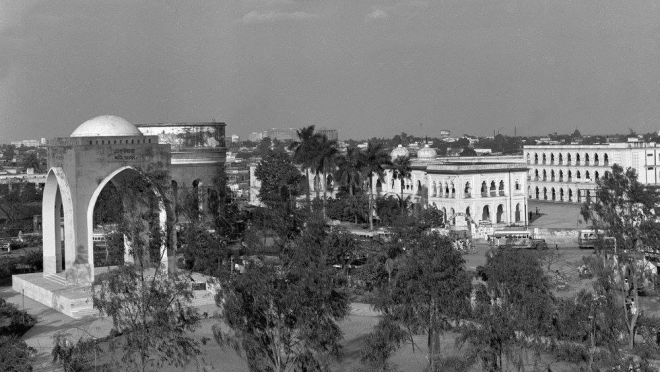
It took the centenary of the mutiny itself for the park to get its memory back. In 1957, a hundred years after the hangings, Dhaka renamed the ground Bahadur Shah Park after Bahadur Shah Zafar, the last Mughal emperor, the ageing poet king the mutineers had rallied around and declared their ruler, and who the British deposed and exiled to Rangoon to die a stranger in his own defeat. A cenotaph went up not long after, four pillars and a small dome.
So the park has worn three names in under two hundred years. A billiard house. A queen. A dethroned emperor who never once set foot on this soil but whose name was still the only one honest enough to hang the story back where it belonged.
And still, on a Friday afternoon in Bangla Bazar, an old man calls it Victoria Park to his son, because somewhere his own father called it that to him, and history, it turns out, moves slower through a family than it does through a gazette notification.
I finished my tea. I paid for the chaap and the cutlet. I got up and walked out of Cafe Corner, north, towards a squat red building the older residents still call Laalkuthi, though its real name is Northbrook Hall. Next time, I will tell you about that hall, and about the road that runs past it carrying the only thing left of a community that once ran this city’s trade and gave a park its first, smallest name. Armanitola.