Is reality real, or just in your mind? Rethinking knowledge on Kant's birthday
Have you ever wondered how we know what we know? Where does our knowledge come from? Some might say we learn from what we see and what we hear. But what if knowledge does not come only from our sight and hearing? Can our understanding of the world come from within us? This is the idea behind transcendental philosophy. It tries to answer a simple but deep question:
Is reality real, or just in your mind? Rethinking knowledge on Kant's birthday
Have you ever wondered how we know what we know? Where does our knowledge come from? Some might say we learn from what we see and what we hear. But what if knowledge does not come only from our sight and hearing? Can our understanding of the world come from within us? This is the idea behind transcendental philosophy. It tries to answer a simple but deep question:
How do we know what we know?
Human knowledge is shaped not only by the world around us but also by the structure of our own mind. According to this philosophy, known as transcendental philosophy, the mind does not passively receive information. It actually organises experiences through basic forms such as space and time.
This means we never see reality exactly as it is, but as our mind presents it to us.
For example, two people may watch the same event but understand it differently based on their background, beliefs and expectations. The event is the same, but the experience is shaped by their mind. This philosophy can also be connected to the question of free will.
Since we can only know the things that we can experience, we cannot know anything about how things are in themselves.
In particular, we cannot know anything about God or the soul. And we cannot know whether we have free will or not. The way I experience myself is determined by the laws of nature, but for all I know, in independent reality I might be completely free or not at all.
Do you know who developed such thought-provoking ideas?
Immanuel Kant, and today marks the birthday of this great thinker.
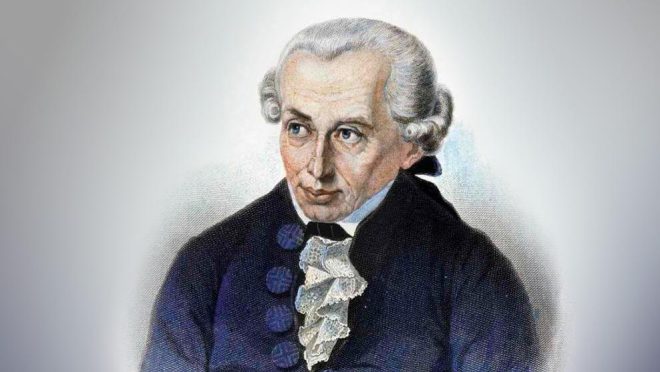
Kant was born on 22 April 1724 in Königsberg, a city in Prussia. He came from a modest family. His father was a harness maker and his mother was deeply religious. Later in life, he attended the University of Königsberg and worked there as a teacher after graduation.
Kant is best known for his work in philosophy, especially in knowledge, ethics and reason. In his major work Critique of Pure Reason, he explained how the human mind shapes experience. He argued that we cannot know things as they are in themselves, only as they appear to us.
Furthermore, Kant provided an interesting view on ethics. Since we are unable to know whether we have free will or not, we are allowed to believe that we do. However, Kant thinks we only act freely if our actions come forth from a principle that we have posed ourselves. He calls such principles maxims. But we cannot just posit any principle to ourselves. We are natural beings; we have the ability to reason.
Our reason demands that any such principle obeys the Categorical Imperative: Act only according to that maxim whereby you can, at the same time, will that it should become a universal law. Basically, this means that we cannot act freely on principles that allow us to steal, lie or kill, as we cannot reason that such principles would become a universal law.
In his later life, Kant became widely respected. He continued to write and teach, though his health declined with age. He died in 1804, leaving behind ideas that still shape modern thought.
Today, Kant’s philosophy remains important. In a world filled with fast imagination, digital images and conflicting truths, his ideas remind us to question how we know things. His ethical thinking also challenges us to act with responsibility and respect rather than simply seeking personal benefit.
As we remember him on his birthday, let us rethink our understanding of our mind and knowledge.