AI won't replace graduates. Graduates who use AI will replace those who don't
AI won't replace graduates. Graduates who use AI will replace those who don't
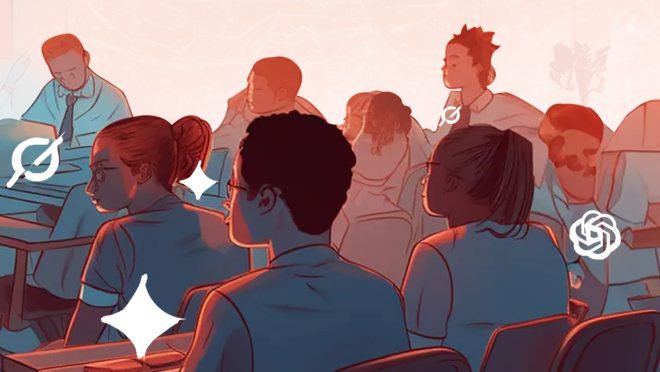
Two graduates walk into the same job interview.
Both studied at reputable universities. Both earned impressive CGPAs. Both communicate confidently. Both completed internships. On paper, their résumés look almost identical.
Then the hiring manager gives them a challenge.
Analyse a new market. Identify industry trends. Prepare a presentation. Recommend a launch strategy. You have two hours.
One graduate immediately collaborates with Artificial Intelligence. They use AI to gather insights, analyse data, explore multiple strategies, verify sources, refine recommendations and produce a polished presentation.
The other spends most of the time manually searching the internet, piecing together information and racing against the clock.
Who gets the job?
Increasingly, the answer is obvious.
The future of graduate employability will not be determined by whether Artificial Intelligence replaces people. It will be determined by whether graduates know how to work alongside AI. That distinction is rapidly becoming one of the defining workforce issues of our time.
Much of the public conversation around AI swings between two extremes. Some predict mass unemployment and the disappearance of entire professions. Others dismiss AI as another passing technological trend. Neither view reflects reality.
History offers a useful perspective. Calculators did not eliminate accountants. Spreadsheets did not replace financial analysts. Computer-aided design did not make architects obsolete. Search engines did not end libraries. Instead, these technologies transformed how professionals worked. Those who embraced them became more productive, while those who resisted gradually fell behind.
Artificial Intelligence is following the same pattern, only at unprecedented speed.
Research from organisations such as the OECD, the International Labour Organization, McKinsey & Company and the World Economic Forum consistently reaches a similar conclusion. AI is far more likely to automate tasks than entire occupations. Jobs evolve. Responsibilities change. New roles emerge. Human capability becomes even more valuable when combined with intelligent technologies.
The competition is no longer humans versus AI. It is increasingly humans with AI versus humans without it.
This transformation is visible across almost every profession.
Doctors now use AI to detect diseases from medical images more quickly while retaining full responsibility for diagnosis and patient care. Lawyers rely on AI to review thousands of legal documents in minutes, allowing them to focus on strategy, negotiation and advocacy. Teachers generate personalised learning materials and faster feedback, creating more time for mentoring students. Engineers use AI to optimise designs, simulate complex systems and identify potential failures before construction begins.
Journalists are also adapting. AI can transcribe interviews, analyse large datasets and monitor breaking developments, but editorial judgement, verification and ethical decision-making remain fundamentally human responsibilities. Financial analysts use AI to detect fraud and identify market trends, while marketers analyse consumer behaviour and personalise campaigns with unprecedented precision. Human resource professionals increasingly screen large pools of applicants using AI, yet final hiring decisions still depend on human judgement, cultural understanding and emotional intelligence.
Even agriculture, often perceived as a traditional sector, has embraced AI-powered crop monitoring, precision irrigation, weather forecasting and disease detection.
Across every industry, one pattern is becoming increasingly clear. AI excels at repetitive, data-intensive and predictable tasks. Humans remain indispensable where judgement, empathy, creativity, ethics, leadership and complex decision-making matter most.
Unfortunately, higher education has not always kept pace with this transformation.
Across much of the world, including Bangladesh, universities continue to reward memorisation more than problem-solving. Students spend years preparing for examinations that often measure how much information they can recall rather than how effectively they can apply knowledge.
Ironically, information retrieval has become one of AI’s greatest strengths.
Many students already use generative AI to draft assignments, create presentation slides or prepare for examinations. While these uses save time, they represent only a fraction of AI’s potential.
Far greater value lies in using AI to analyse complex problems, explore competing perspectives, conduct literature reviews, generate business ideas, write software, interpret datasets, simulate scenarios, develop entrepreneurial solutions and accelerate lifelong learning.
Employers increasingly expect graduates to possess these capabilities. Yet many leave university without ever being taught how to use AI effectively, responsibly or critically. The gap between classroom learning and workplace expectations continues to widen.
Just as computer literacy became essential three decades ago and internet literacy became indispensable two decades later, AI literacy is rapidly emerging as the next foundational skill.
However, AI literacy means far more than knowing how to open ChatGPT or another chatbot. It requires understanding what AI can and cannot do, recognising hallucinations, identifying bias, verifying sources, protecting confidential information, respecting copyright, understanding privacy risks and appreciating ethical implications.
Graduates who accept every AI-generated response without question risk becoming less informed rather than more capable. The real value of AI literacy lies not in trusting AI blindly but in knowing how to question it.
Critical thinking, once considered essential for navigating the information age, is becoming equally essential for navigating the intelligence age.
Universities therefore have an equally important responsibility to teach responsible AI use.
The rise of AI has created legitimate concerns around plagiarism, misinformation, deepfakes, intellectual property, privacy and academic integrity. Ignoring these issues would be a serious mistake.
Students must understand that AI should support thinking rather than replace it. Submitting AI-generated assignments without understanding the content does not develop competence. Using AI to fabricate research, manipulate images or spread misinformation undermines trust in both education and society.
Responsible AI requires transparency, accountability, ethical judgement and human oversight. Increasingly, these qualities are becoming graduate attributes in their own right.
One of the most underestimated career skills today is prompt engineering.
Despite its technical-sounding name, the principle is straightforward. AI produces better results when people ask better questions.
A business student might ask AI to evaluate market-entry strategies for Bangladeshi start-ups while considering regulatory risks. An engineering student could compare alternative design solutions that balance cost, sustainability and safety. A law student may examine legal precedents across jurisdictions. A medical student could request explanations of treatment options supported by the latest clinical evidence while identifying their limitations. Journalists can explore multiple interview angles before conducting independent reporting. Researchers can identify knowledge gaps and organise literature more efficiently. Entrepreneurs can refine business models, identify customer segments and strengthen investment pitches.
Prompting is rapidly becoming a modern communication skill that combines curiosity, clarity, analytical thinking and subject expertise.
Increasingly, the quality of the question determines the quality of the answer.
The most successful graduates will not use AI as a shortcut. They will use it as an intelligent assistant.
AI can accelerate research, summarise lengthy reports, generate computer code, analyse spreadsheets, improve writing, design presentations, organise projects, prepare for interviews, develop personal brands and support continuous learning. Tasks that once required several hours can often be completed in a fraction of the time.
Yet speed alone is not the objective.
Productivity gains matter only when combined with critical thinking. AI should amplify human capability, not replace human responsibility. The graduates who thrive will be those who combine technological efficiency with intellectual curiosity.
This reality demands a fundamental rethink of university education.
Adding a single AI course to an existing curriculum will not be enough. AI should become an integral component of every discipline. Business students should learn AI-assisted decision-making. Engineering students should master AI-supported design and simulation. Medical students should understand clinical AI systems alongside ethical patient care. Law students should explore legal technologies and algorithmic accountability. Journalism students should study AI-assisted reporting while strengthening verification and media ethics. Education students should learn AI-enhanced teaching methods.
Assessment methods also need to evolve. Universities should place greater emphasis on authentic problem-solving, project-based learning and real-world application rather than memorisation alone. Faculty development deserves equal attention, enabling educators to redesign learning experiences and model responsible AI use. Industry partnerships should continuously inform curriculum updates, ensuring graduates remain aligned with rapidly changing workplace expectations.
Employers, meanwhile, increasingly seek something more valuable than technical expertise alone.
They want graduates who combine AI capability with critical thinking, creativity, communication, adaptability, collaboration, ethical judgement, emotional intelligence and a commitment to lifelong learning.
The World Economic Forum consistently identifies analytical thinking, resilience, technological literacy, creativity and continuous learning among the fastest-growing workforce skills. Employers are not necessarily searching for AI experts in every role. They are searching for professionals who know how to use AI wisely while exercising sound human judgement.
For Bangladesh, this conversation carries particular urgency.
The country possesses one of the world’s youngest populations, creating an extraordinary demographic opportunity. Yet graduate unemployment and underemployment remain persistent challenges despite the growing number of university graduates. Many employers continue to report significant mismatches between academic preparation and workplace expectations.
At the same time, Bangladesh’s ambitions to build a Smart Bangladesh, participate in the Fourth Industrial Revolution, expand digital entrepreneurship, strengthen freelancing and integrate into global knowledge industries all depend upon an AI-ready workforce.
This is no longer simply an education issue. It is an economic competitiveness issue.
Bangladesh’s universities have an opportunity to position themselves as producers of globally employable graduates rather than simply degree holders. Institutions that embrace this transformation early will help shape the country’s future talent pipeline.
Preparing graduates for the AI era requires shared responsibility.
Students should treat AI as a learning partner rather than an assignment generator. Faculty members should redesign learning experiences that encourage inquiry, critical thinking and responsible AI use. Universities should embed AI across disciplines, strengthen industry partnerships and modernise curricula. Employers should recruit for adaptability and provide opportunities for AI upskilling. Government should support national AI literacy initiatives, encourage university-industry collaboration and invest in workforce reskilling. Parents should value curiosity, digital competence and lifelong learning alongside examination results.
Every technological revolution reshapes the labour market.
The Industrial Revolution rewarded those who mastered machines. The Information Age rewarded those who mastered computers. The AI era will reward those who learn to collaborate with intelligent systems while preserving the uniquely human qualities that no algorithm can fully replicate.
History rarely rewards those who resist technological change. It rewards those who learn, adapt and lead through it.
Artificial Intelligence will not determine who succeeds.
Our willingness to think critically, learn continuously, act ethically and work intelligently alongside AI will.
The graduates of tomorrow will not be defined by how much they know. They will be defined by how effectively they learn, adapt and create value with AI.
That future has already begun.
Manjurul Haque Khan is the Director of the Office of Career Guidance, Placement & Alumni Relations at Independent University, Bangladesh (IUB).
Disclaimer: The views and opinions expressed in this article are those of the author and do not necessarily reflect the opinions and views of The Business Standard and TBS Graduates