Who carries the burden of failure?
If yesterday’s numbers were to remain similar after the re-examination phase, nearly 9 lakh seats would be vacant in public, private and national universities combined.
Who carries the burden of failure?
If yesterday’s numbers were to remain similar after the re-examination phase, nearly 9 lakh seats would be vacant in public, private and national universities combined.
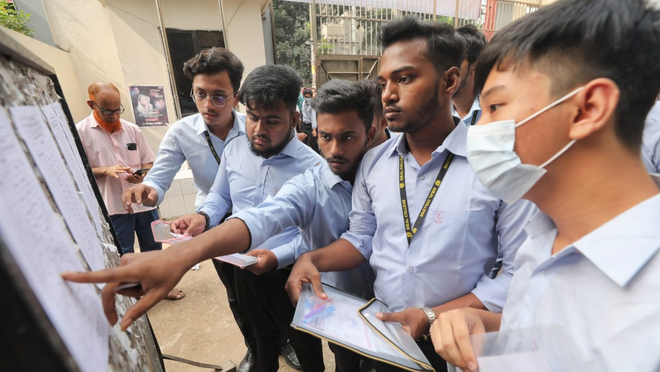
Which begs the question: with almost half of the candidates remaining ineligible to pursue undergraduate education and with little to no skill-based education mediums to fall back upon, aren’t we the ones failing these children in the first place?
Over-bloated success stories of the previous regime have been a stain on the country’s ability to produce productive human resources for almost 20 years. The subsequent interim and now the elected governments have clamped down on leniency in evaluation and standardised the board question to the point that memorising test papers and expecting common questions are no longer valuable shortcuts to success.
While this strictness is commendable, their approach of this top-down standardisation has exposed significant gaps in the education system. The gaps range from teacher shortages to the very quality of the classrooms, and all the factors resulting in these voids are not the fault of our children but of our reluctance to ask the deeper questions in hand.
Why hasn’t the state been able to ensure universal education? Why is the quality of teachers in rural cities and townships so drastically different from the elite schools of the capital? And why can’t corrupt mediaeval practices of rote learning and guidebook adherence be fully eradicated?
According to data from the Bangladesh Bureau of Educational Information and Statistics (Banbeis) and the Directorate of Secondary and Higher Education (DSHE), 2,842 teaching posts remain vacant in government secondary schools. The number of vacancies in MPO-listed private secondary institutions is much higher, at 77,227.
Why? Well, if you read up on why Bangladeshi policies tend to get stuck, the first culprit is and always will be the bureaucracy. For government secondary schools, the hiring process must route from individual schools to the Directorate of Secondary and Higher Education (DSHE), then through the Ministry of Education, and finally to the Public Service Commission (PSC). Which means the journey from releasing a circular for hiring teachers, and then performing the recruitment exams and interviews, requires the intervention of three different departments, which invariably leads to deadlocks and bureaucratic red tape.
The recruitment figures of MPO institutions show that only 18,399 applications were submitted against 67,087 advertised vacancies last year. Which leaves the greater question of having enough eligible graduates, or them wanting to enter this profession in the first place.
Among the above-mentioned 18,399 applications, only 11,713 candidates were recommended, leaving tens of thousands of roles empty.
The teacher shortages are felt harder at the corners of the country where the socioeconomic situations do not incentivise recruitment. Most of the vacant placements, on top of that, are in the disciplines of STEM fields, leading to more skilled educators in the rural areas.
So, if a failed student from rural parts of Barisal questions us on why we decided to “standardise” the question paper all of a sudden, all while leaving him without a good school, qualified teachers, and an economic condition that cripples his progression, can the state honestly give a proper answer?
Is the state working to resolve dozens of court cases that blocked promotions citing recruitment rules, exam modifications, and appointment quotas? The education minister a few months ago in the parliament stated that the ministry is working on it; to what end still is unclear.
Is the state accounting for the number of graduates from universities and incentivising them to join the education sector as a suitable career choice?
Will a recent Master’s graduate in Chemistry be willing to join his local MPO or even government institution as a high school chemistry teacher, knowing the lack of adequate salaries and highly restricted career growth?
If the answer to all of these questions is not a clear “YES”, we have no right to blame the failing 47.8%.
Disclaimer: The views and opinions expressed in this article are those of the author and do not necessarily reflect the opinions and views of The Business Standard and TBS Graduates.