I’m sorry. The Odyssey was a disappointment
There was a time when I, as a young cinephile, used to think that maybe, in the literary sense, Christopher Nolan could not make bad films.
I’m sorry. The Odyssey was a disappointment
There was a time when I, as a young cinephile, used to think that maybe, in the literary sense, Christopher Nolan could not make bad films.
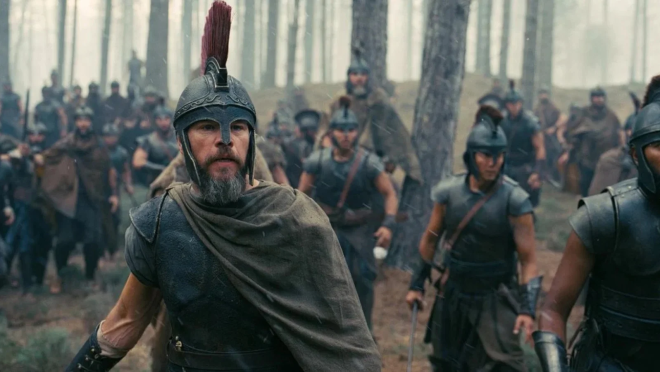
As I grew older and read more texts, I found out I was clearly wrong. Probably somewhere around Interstellar, when Christopher Nolan stopped being a filmmaker who used scale to serve a story and became a filmmaker who used story as an excuse for scale.
Clearly, that film was actually very good and told a story based on scientific assumptions that led the story to where it went. Then, Dunkirk was a film no one questioned (maybe to some it was boring) to be great, specifically the filmmaking and the background music.
Afterwards, Tenet was a diagram that, quite literally, forgot to become a movie. In my books, Oppenheimer got away with it because the subject matter, a man building a weapon he can’t uninvent, was finally big enough to match Nolan’s appetite for grandiosity. It told a story that was worth mentioning because that shaped the next century of geopolitics. Again, that too can be presumptuous.
The Odyssey is not that subject. And three thousand years of literary history are not shy about pointing out the difference. It talks about a religion that not only was followed by many in the early centuries, but also made the heroes of your favourite heroes, heroes.
The reaction to The Odyssey has followed the usual Nolan pattern: a wave of critics calling it the crowning achievement of his career, IMAX cameras and all, and a quieter but more persistent group asking what actually got said with all that technical firepower. It’s the same split that followed Tenet and, to a lesser degree, Dunkirk, reviews that admire the machinery of the thing while admitting they never felt swept up in it. “Impressive” and “moving” have stopped being synonyms in Nolan’s later career, and The Odyssey is maybe the clearest example yet of a film that earns the first word without ever managing the second.
What’s telling is how many people who love the poem are the ones pulling back hardest. The complaint isn’t that the film is boring or badly made; it’s that it forgets what made this specific story worth telling in the first place.
To see what’s been lost, you have to know what The Odyssey is actually doing. Composed around the 8th century BCE but set in the Mycenaean “age of heroes” near 1200 BCE, the poem isn’t really an adventure story, it’s a meditation on nostos (homecoming), xenia (the sacred duty of hospitality), and metis (cunning intelligence as a heroic virtue in its own right, distinct from brute strength).
Odysseus survives not because he’s the strongest man in the room but because he’s the smartest, a trickster-king whose disguises, patience, and capacity for deception are the entire point of the character. The poem ends not in ambiguity but in restoration: the rightful king reclaims his household, his marriage bed, and his throne, and the killing of the suitors is framed as justice, not tragedy. Taking a human life is not at all a moral act; it is about the emotions that drive the act.
Throughout history, people tried to justify this act solely by bringing in justified human emotions, or else taking a human life would not feel as valiant as it did. Such is the case here; had he not had the determination that what he was doing was correct, he would not have felt the way he did.
That’s the text Nolan is supposedly adapting. It’s worth being precise about how far he’s actually strayed from it.
Penelope and Telemachus, whose dynamic in Homer is defined by a son repeatedly silencing his mother and asserting that “speech is the business of men”, get flipped entirely, in the film, it’s Penelope doing the scolding, openly wishing violent death on the suitors herself. It’s a modern instinct: give the woman more agency, but do it by making her sound like a 2026 screenwriter’s idea of a strong female character rather than reckoning with what her actual silence in the original meant. This, in my opinion, has been the start of the reckoning for me.
See, it’s not necessarily about being misogynistic or about being a hater of feminine agency; it’s about the authenticity of the text. You can’t assume you can “change” an original text in the pursuit of “intellectual” or “artistic” freedom. That not only questions the integrity of the context, but also warps the divinity of the story that Rome held so close to its heart for centuries.
The monsters fare just as strangely. The Laestrygonians, cannibal giants who hurl boulders and annihilate eleven of Odysseus’s twelve ships in the poem, become armoured knights who trap the crew using manipulated forest wood, a much tidier and much less mythic threat that costs the fleet only two ships.
And in trimming six hundred pages into three hours, Nolan cuts the entire stay with the Phaeacians on Scheria, which happens to be the section most concerned with hospitality as a civilising force, arguably the poem’s actual thesis statement. You can lose a lot of incident from an epic and still keep its soul.
Losing the chapter about why hospitality matters, from a poem whose entire moral universe runs on hospitality, is a weirder kind of cut. This is not only unnecessary but also unusual in the artistic sense. You cannot be a modern artist without knowing how to draw a sparrow.
The characterisation is where the betrayal runs deepest. This Odysseus has none of the cleverness, humour, or seductive charm that make him one of literature’s great tricksters, instead, he’s another guilt-ridden, haunted man, cut from the same cloth as the amnesiac in Memento, the vigilante in The Dark Knight, the physicist in Oppenheimer. It suggests Nolan didn’t actually adapt Homer’s hero so much as retrofit Homer’s plot onto the one character type he already knows how to write, over and over, regardless of the source material. I can imagine so many other casting choices better suited for this specific role, and the others with better candidates who have similar advances in their careers.
The ending is where it all comes apart completely. Homer’s poem builds toward homecoming, a king restored to his household, his marriage, his throne, with the slaughter of the suitors vindicated rather than mourned. Nolan’s Odysseus instead abdicates the throne to his son and sails off alone, trading restoration for self-exile.
This, to me, was funny as it disregards the entire framework of moral design in the poem. And the film invents new cruelty Homer never wrote: suitors tormenting Odysseus’s ageing dog throughout his absence, so that the dog’s suffering becomes the trigger for the final killing spree. It’s wholesale shoplifting from John Wick, and put together onto a three-thousand-year-old poem that really didn’t need it.
Even the production design courted trouble before a single frame reached theatres. Early images showed Odysseus in a Corinthian-style (you’ll see a similar design in the pillars of the oligarchs of our country, i.e. the mansion of Sobhan Anvir that is taken from late Roman pillars) helmet, a design that didn’t exist until centuries after the Bronze Age setting the poem describes, where the actual gear would have been leather and boar tusk (and, of course, remnants of the armour given by Athena herself).
A small detail, maybe, but it’s the same instinct running through every wider choice: reach for the version of “ancient Greece” that reads as legible spectacle, rather than the version that was actually true to the period or the text.
Nolan hasn’t hidden the fact that fidelity was never the goal. He’s said outright that the film isn’t strictly accurate to Homer, and that he deliberately modernised the language, casting, and design to chase contemporary emotional resonance instead of historical or textual replication.
That’s a legitimate approach in the abstract, adaptation has never required transcription, and no film needed a correct Bronze Age helmet to succeed as drama. However, one cannot insult the divinity of the story, neither acquires so merely by the cost of intellectual freedom.
But the direction of the changes gives the game away. Nolan didn’t loosen the poem to make room for more of his own ideas; he replaced xenia and metis with guilt and trauma because those are the only emotional registers he’s shown real facility with across two decades of filmmaking and the traditional emotions in recent decades.
The film borrows the shape of the epic, the ten-year voyage, the suitors, the bow contest, the slaughter, and empties the values that kept it alive for twenty-eight centuries, filling the space with a modern trauma-response narrative that ends in regret.
The Odyssey looks like a masterpiece from a hundred yards away and reads as a hollowed-out imitation up close. Homer’s poem is about a man clever enough to get home. Nolan’s version is about a man too haunted to want to.