The genius of Meena was that it never felt like a lesson
Meena was one of the very few local-language cartoons Bangladesh ever produced. For most of us who grew up in the 90s and 2000s, it was simply a cartoon we watched between homework and dinner. It was about a spirited nine-year-old girl, her mischievous parrot Mithu, and her brother Raju, carrying storylines that felt familiar and relevant in a way imported cartoons never did.
The genius of Meena was that it never felt like a lesson
Meena was one of the very few local-language cartoons Bangladesh ever produced. For most of us who grew up in the 90s and 2000s, it was simply a cartoon we watched between homework and dinner. It was about a spirited nine-year-old girl, her mischievous parrot Mithu, and her brother Raju, carrying storylines that felt familiar and relevant in a way imported cartoons never did.
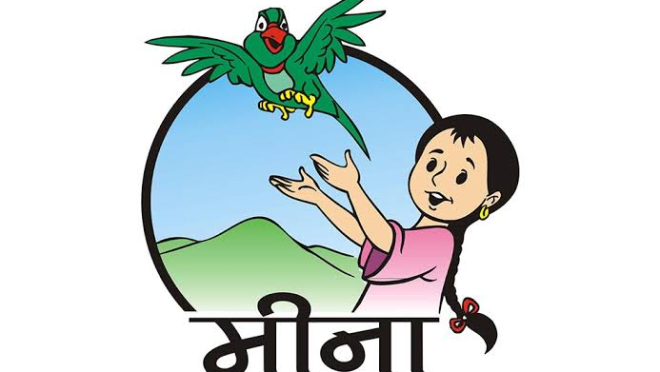
Growing up, looking back, many of us realise that Meena was never really made for entertainment alone. It was built, deliberately and painstakingly, to change how an entire region thought about its daughters.
That intention was there from the start, and it shows in how slowly and seriously the cartoon was built. Meena was conceived in 1990 inside the communication section of Unicef Bangladesh. It was carefully developed with research behind every choice. Before a single frame was animated, Unicef spoke to more than 10,000 children across South Asia, asking them what Meena should wear, how she should talk, and what kind of life she should lead. Most children’s media is built by adults guessing at what children want. Meena was built by asking them. The name itself was chosen because “Meena” is common across South Asia, recognisable in a Bangladeshi village, an Indian one, a Nepali or Pakistani one alike, so that no child watching would feel like it belonged to someone else’s country. Its debut episode, “Count Your Chickens,” aired on Bangladesh Television in 1993, telling the story of a girl fighting to stay in school. It was a modest beginning for something that would eventually be recognised across an entire region.
That fight, a girl fighting to stay in school, was the story most of us watched without realising it was our own, or someone else’s just like it. For urban kids, Meena was just a cartoon, background noise before dinner. For the larger majority, it was something else entirely, a message aimed quietly at parents, telling them their daughters deserved an education, a mirror held up to a reality many children were already living every single day.
In rural homes, a little bit of Meena existed in every girl child. The one pulled from school early. The one fed last. The one married off before she was ready. It’s a rare thing for a cartoon to carry that much weight and still be watched for fun.
Meena Elo Shohore made that mirror impossible to look away from. It portrayed a side we often avoid, where Meena had to work as a house help, while Raju, sent to work in the city, wrote to her saying he had never worked this hard in his life. This is not just a story. It is the reality of the many kids we see around us every day. Kids who come to the big city with big expectations, only to watch those get lost in the struggle. A childhood spent working instead of playing.
The episodes simply portrayed serious issues like health awareness, child marriage, girls’ education, eve teasing, and these were carefully woven into the storyline, and this is where Meena’s excellence lay. Nobody stopped the story to explain the lesson. The lesson was the story.
Meena o Dustu Chele took on that last issue directly. The episode showed a group of boys who used to tease girls on their way to school, the kind of everyday harassment so common it barely gets noticed, let alone named. Meena eventually taught them a lesson, and the episode closed on a message that stayed simple and direct: eve teasing is something to be discouraged, not laughed off or ignored. It is the kind of storyline that could easily have turned preachy, and did not.
Dividing the Mangoes did something similar in miniature, and maybe more effectively. Meena and Raju’s daily routine, shown swiftly and without lecture, revealed how both boys and girls do hard work, each hard in its own way, neither to be neglected, both deserving equal treatment. There was no big speech about equality. There was just a mango, a meal divided, and Mithu the parrot noticing it wasn’t divided fairly.
The scripting was built in a way that would never bore its audience, and that restraint is harder to pull off than it looks. As kids, we just saw a cartoon. The storytelling was arranged so the educational content never felt educational. It leaned towards entertainment instead, and it is precisely because of that that the intended message actually landed. A show that felt like a lecture would have been switched off. Meena never was.
That same instinct shaped how the cartoon spoke. It used the local accent most people actually used, not the polished, textbook Bangla of a classroom, but the real, everyday version spoken in real homes. Some modern parents wouldn’t let their kids watch it because of how the characters talked, but that was exactly where Meena’s strength lay. A cartoon that sounds like home reaches further than one that sounds like a lesson.
Like most good cartoons, Meena didn’t try to teach kids to be “ideal.” It showed them the reality of society, what was happening, and what needed to change, and trusted the audience to draw their own conclusions.
That honesty is what carried Meena across regions. The cartoon went on to star in dozens of films, radio programmes, comics, and books, translated and dubbed into languages across India, Pakistan, Sri Lanka, Nepal, and Bhutan, and eventually into Laos, Cambodia, and Vietnam as well. Very few local-language productions have ever travelled that far while staying recognisably themselves. Meena wasn’t localised for each new country. It simply belonged everywhere from the start.
And it hasn’t stopped. Unicef still talks to children to produce relevant new content. Meena now even creates episodes about internet awareness, proof that the cartoon was never frozen in the 1990s. With time, its stories have evolved, and it continues to produce impactful episodes to this day.