The man embodying a slogan
Most political slogans last a few days. Sometimes they get painted on a wall, the rain gets to them, and a municipal worker whitewashes the rest. However, the slogan written on Noor Hossain’s body has lasted almost four decades.
The man embodying a slogan
Most political slogans last a few days. Sometimes they get painted on a wall, the rain gets to them, and a municipal worker whitewashes the rest. However, the slogan written on Noor Hossain’s body has lasted almost four decades.
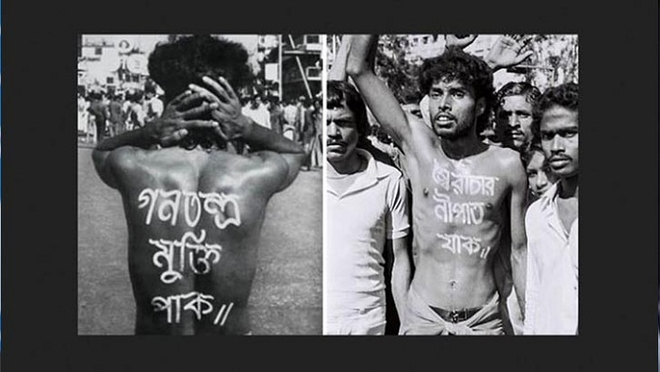
On 10 November 1987, a young man in his mid-twenties stripped to the waist and walked into the streets of Dhaka. On his chest he had written Gonotantra Mukty Pak, “Let democracy be freed.” On his back: Sairachar Nipat Jak, “Down with autocracy.”
Near Gulistan, police fired, and he was killed. Noor Hossain, who by most accounts earned his living with his hands, never got to see the next page of the story.
We usually remember him as a martyr, and he was one. But look at what he actually did before he was shot: he made a decision about how to speak.
Placards, banners, leaflets can be confiscated, but a slogan on your own skin cannot be taken from you without taking you. By writing on his body, Noor Hossain made the most honest kind of statement, one with no gap between the message and the messenger.
An ordinary author
The most striking thing, in my opinion, is that neither a manifesto nor a party office produced the most insightful political speech of that time. It originated from someone who wasn’t typically associated with intellectuals and leaders.
There is a lesson here for people who think politics belongs to professionals. Movements are often given their vocabulary by those with the least power.
The long afterlife of a sentence
He was not the last member of the movement. It took three more years of strikes, marches and funerals before authoritarian control ended in December 1990. However, the slogans continued. Long after most people had forgotten the identity of the minister who gave the order for the crackdown, the Gulistan crossroads was given his name, and the words from his chest and back were repeated in following protests.
Every generation since has found its own version of the same impulse: writing a demand somewhere impossible to ignore. Walls, bridges, faces, flags, even the backs of schoolbags. Whether or not they knew his story, they were using his method.
What to do with a memorial day
There’s a risk with days like 10 November. They turn into ceremonies: wreaths, speeches, a quick photograph, a post on social media.
A better way to commemorate him would be to pose the question that he answered with his life: “What is the one sentence you would be willing to stand behind in public, with nothing to hide behind? Not with a hashtag or a borrowed line, but a sentence that might cost you something?”
Noor Hossain had two, which he wrote in front of the entire city and paid for. Even after almost 40 years, they are still manageable to memorise and heavy enough to carry.
That’s how a Dhaka mechanic outlasted a regime, not by being powerful, but by being blatantly obvious.