Women on campus: Between empowerment and everyday fear
A university campus is supposed to be the safest place for a student, especially for a female student who is supposed to embody the term ‘freedom’ from her very own campus.
Women on campus: Between empowerment and everyday fear
A university campus is supposed to be the safest place for a student, especially for a female student who is supposed to embody the term ‘freedom’ from her very own campus.
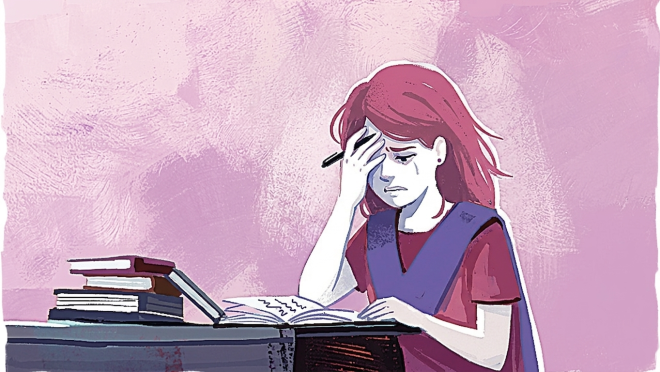
The campus should be the place which teaches her to dream, have ambitions, and to live a life full of knowledge and independence that can possibly triumph over the boundaries imposed on her by society.
But sadly, university campuses often become places where women learn to be scared more intimately. Before learning anything worth mentioning, they become cautious; they learn survival methods. They memorise the roads to avoid after dark, notice the footsteps that are not safe, and prepare themselves for the exhausting methods of safety that follow them through every door and empty street.
Despite all the safety measures, laws and orders, are they safe in their own institutions? Can they breathe independently within the campus?
What makes it more devastating is the repetition of such incidents on campus. Recently, a disturbing event took place on the campus of Jahangirnagar University, where a female student was attacked and an attempt was made to rape her by an outsider.
This is not just a crime report; it is a collapse of a moral promise that the authority was bound to fulfil. A promise to protect the very students of the institution. Often, it feels like there is an unspoken rule of our university authorities that they forget that an educational institution is not merely a collection of classrooms and examinations.
It is a place built on the trust of the students. But this is shameful when a female student cannot walk safely inside the university. This is the moment when an institution stands morally exposed that advertises itself as progressive and secure from any harm. The university has long carried the burden of repeated allegations involving sexual assault, harassment, and often violence. But nothing changes, and the incidents only become a cycle that slowly dissolves into silence.
Is it the cruellest reality for a Bangladeshi woman not to feel safe or to survive the unpleasant circumstances?
Perhaps, it is. Every female student inherits a safety map as soon as she enters university life. There is a certain time frame that allows her to stay outside. This particular time frame is an indication that maybe she is not safe after that hour.
Because then certain roads become forbidden, and certain areas become dangerous for her. Even the restrictions inside the university halls silently indicate that fear inside the campus is real. And when you are not a good rule follower, the burden quietly shifts from institutions to your own responsibility. Either you protect yourself, or die a pathetic death.
What should terrify us is its growing normalisation. When such a situation erupts, the administration responds with polished statements instantly, a temporary protest outrage by the students, but the underlying problem stays the same.
The authority becomes more concerned about protecting the image of the university than finding out the root causes. And the psychological safety of the female students remains unnoticed. The message is quite clear: the answer to women’s safety is always optional. This is not merely a problem of Jahangirnagar University; it is a problem that is too reluctant to stay within the borders of a country.
The 2024 RG Kar Medical College rape and murder case in Kolkata reminds us how harrowing an incident could be, how unsafe a woman could be, even within her own campus. So many questions arise in our minds, but we don’t know who is responsible for giving answers to us or who to ensure our safety, because the people in power are always silent, as if occurrences like these are normal in a country.
The tragedy is that women are becoming accustomed to such cruelty, and it is beyond heartbreaking that fear is becoming a routine for them. Is this the final call for a woman to wake up and not be dependent on anybody for her safety?
At least the JU incident tells us that being your own protector is now the biggest responsibility as a woman. The question now is no longer whether women belong in the university. They have already earned that place there. It is about the university authority, whether they can ensure the women’s safety on campus.
The question is whether they are ready to prepare a campus where women can coexist with men without negotiating with fear. Until then, every promise will remain incomplete, and the motivational speech about women’s empowerment will continue to expose the gap between their claim and the lived reality of what women are forced to endure in a society. If it is not fulfilled, every new incident will remind women that educational institutions may give them degrees, but are not necessarily bound to ensure their safety.