Ant queen lays eggs that hatch into two different species
Ant queen lays eggs that hatch into two different species
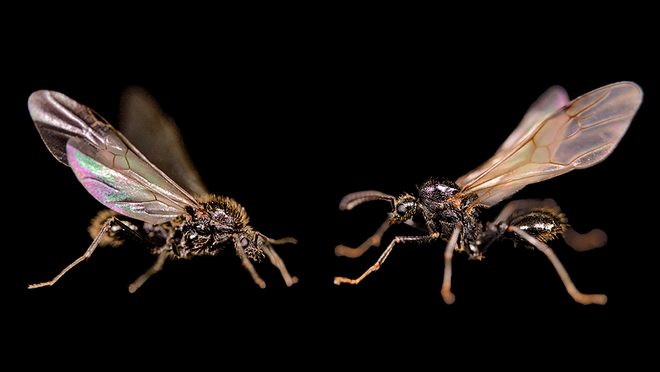
Reproduction is strange in many social insects, but the Iberian harvester ant (Messor ibericus) takes that strangeness to an entirely new level. Queens of the species mate with males of another species and then clone them, researchers report in Nature. This makes M. ibericus the only known organism capable of effectively propagating two different species on its own according to Science.
Evolutionary biologist Jonathan Romiguier of the University of Montpellier, who led the research team, describes M. ibericus as “in a sense, the most complex, colonial life form we know of so far”.
The discovery “is almost impossible to believe and pushes our understanding of evolutionary biology”, says Michael Goodisman, an evolutionary biologist at the Georgia Institute of Technology who was not involved in the research. “Just when you think you’ve seen it all, social insects reveal another surprise.”
Social insects such as honey bees and ants, which live in colonies with intricate divisions of labour, have some of the most genetically complex reproductive systems in the animal kingdom. Queens control much of the process. Before establishing a new colony, a young queen typically mates with winged males during a nuptial flight. She usually makes this flight only once, storing the sperm she collects for the rest of her life, which can last more than a decade in some harvester ants.
Once inside the nest, the queen fertilises some of her eggs but leaves others unfertilised. This gives her control over the different castes within the colony. Fertilised eggs develop into female workers, which build the nest, gather food and care for the larvae. Under particular conditions, such as receiving extra protein as larvae, some fertilised eggs can instead develop into future queens. Unfertilised eggs become males, which typically grow wings and leave the colony to mate with virgin queens.
It was this reproductive complexity that first drew Romiguier to ants. Growing up in a rural village in France, he spent hours watching the insects, fascinated by their synchronised movements. Later, as a university student, he kept harvester ants as pets.
“It’s like a little city, a little society,” he says. “How does it work?”
In 2017, Romiguier and his colleagues discovered that worker ants of M. ibericus had unexpectedly diverse DNA, perhaps indicating that their queens had mated with males from a distantly related species. Further genetic analysis revealed an even more surprising possibility: the fathers of the hybrid workers appeared to belong to M. structor, an entirely different species.
Interspecies mating is already known in a few ant species. In these cases, sperm from a male of another species can help a queen produce sterile workers, while sperm from males of her own species produces new queens. M. ibericus appeared to use a similar reproductive strategy.
But there was a major mystery. Colonies of M. ibericus were thriving in areas where M. structor did not occur, including parts of the northern Mediterranean coast and the Italian island of Sicily. The nearest known M. structor colonies in some of these areas were more than 700 kilometres away.
“It was impossible to imagine,” Romiguier says.
To discover what was happening, the researchers needed to collect male ants, which proved surprisingly difficult. A harvester ant colony can contain as many as 10,000 individuals, but only a small number of males are present at certain times of the year. Romiguier and his colleagues excavated around 50 nests along farm roads near Lyon, France, before finally finding what they were looking for.
The team eventually collected 132 males from 26 M. ibericus colonies. About half of these males were almost hairless and closely resembled M. structor. Genetic analysis revealed that they carried the nuclear genome of M. structor but the mitochondrial DNA of M. ibericus. This combination showed that the males had developed from eggs laid by M. ibericus queens.
The researchers believe the queens are effectively cloning M. structor males. The queens allow M. structor sperm to enter their eggs, but at some stage they remove their own genetic material from the egg nucleus. This prevents normal fertilisation and ensures that the egg develops into a male rather than a sterile female worker.