The last of the Shushuk in the Buriganga? Perhaps not
Despite the Buriganga river’s severe pollution, the endangered Ganges River Dolphin continues to survive in its waters. A year-long survey by the students of Jahangirnagar University along the 27km stretch of the Buriganga River has now provided a clearer picture of the potential population of such dolphins, where they are concentrated and what is still keeping them afloat.
The last of the Shushuk in the Buriganga? Perhaps not
Despite the Buriganga river’s severe pollution, the endangered Ganges River Dolphin continues to survive in its waters. A year-long survey by the students of Jahangirnagar University along the 27km stretch of the Buriganga River has now provided a clearer picture of the potential population of such dolphins, where they are concentrated and what is still keeping them afloat.
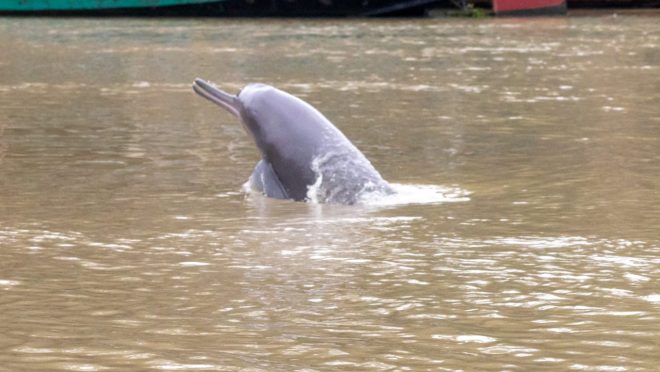
The research, titled Population status, spatiotemporal distribution, and habitat drivers of endangered Ganges River dolphins in the Buriganga River, Bangladesh, recorded dolphin sightings between September 2023 and August 2024.
Statistical analysis estimated the river’s dolphin population at around 20 individuals. The survival of these 20 dolphins in one of Bangladesh’s most degraded rivers is therefore both a sign of resilience and a warning. The Buriganga still supports an endangered species, but the places where these dolphins can safely live may be becoming increasingly limited.
The sightings, however, were far from evenly distributed. Three areas emerged as the main activity zones: Buriganga Riverview to Nabinagar Housing, Kholamora to Bosila, and Pagla to the Buriganga-Dhaleshwari junction. Among them, the Kholamora to Bosila stretch recorded the largest concentration of dolphins.
To get an in-depth view, I talked to Sumaya Khatun, one of the authors of the paper.
What made Sumaya and her team look for dolphins in the Buriganga was that previous records showed Ganges River dolphins were still being sighted.
They wanted to get a better understanding of their current status and habitat use. So, from September 2023 to August 2024, she, along with her team of researchers, conducted monthly surveys along approximately 27 kilometres of the Buriganga River.
“We recorded 57 dolphin sightings during the study period. Using an N-mixture model to account for imperfect detection, we estimated a population of about 20 dolphins. We also found that dolphins were not distributed evenly throughout the river. They were more frequently observed in deeper sections, while areas with heavier boat traffic were used less frequently.”
For Sumaya, perhaps the most important finding from the presence of dolphins is that even a highly degraded river can still retain important wildlife habitat. But their presence should not be interpreted as evidence that the river is on the path towards recovery. Rather, it highlights the need to understand and protect the remaining suitable habitats.
Fish are the main food of Ganges River dolphins. However, during their surveys, they found very little fishing activity and very few fishermen, except to some extent during the monsoon. In some periods, the level of dissolved oxygen was also close to zero.
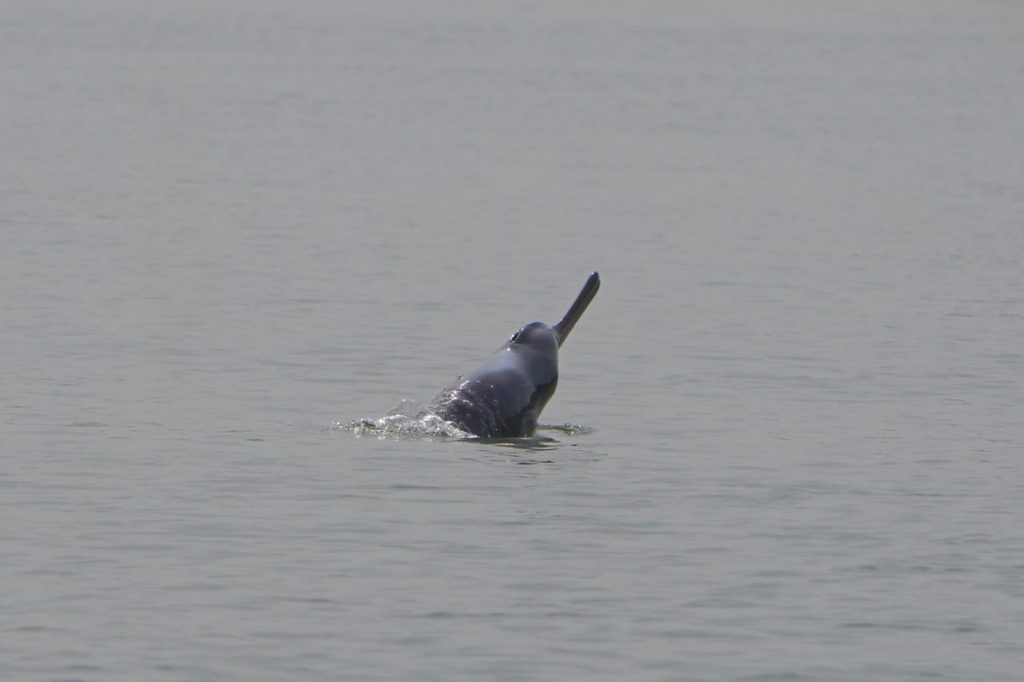
Photo: Courtesy
So, the obvious yet fascinating question arose about the nature of adaptation among the dolphins.
“We suspect that hardy fish species such as suckermouth catfish, which can survive in highly degraded water, may be one of their food sources. However, we do not have direct evidence of this, but it remains a viable hypothesis.”
This is an important area for future research, because understanding prey availability would help them better understand how these dolphins are surviving in such a degraded river.
The most challenging part of conducting this research was finding and observing dolphins among so many cargo vessels and other boats. The Buriganga has heavy vessel traffic, waves and constant disturbance, while dolphins surface only briefly. So, spotting them at the right moment was very difficult.
Another challenge was observing them despite the very poor condition of the water. They had to keep watching the water continuously because even looking away for a moment could mean missing a dolphin.
“Whenever we saw one, we had to quickly record its location and try to take photographs or videos.”
Their methodology divided the river into six sets of approximately five-kilometre segments. During each survey, they travelled along the mid-channel in an engine-driven country boat at an average speed of about 5–6 kilometres per hour. A team of trained observers searched for dolphins from an elevated platform at the front of the boat. They recorded the number of dolphins, their locations using GPS, and other relevant observations. When a group was detected, they stopped the boat and cross-checked the counts using video recordings.
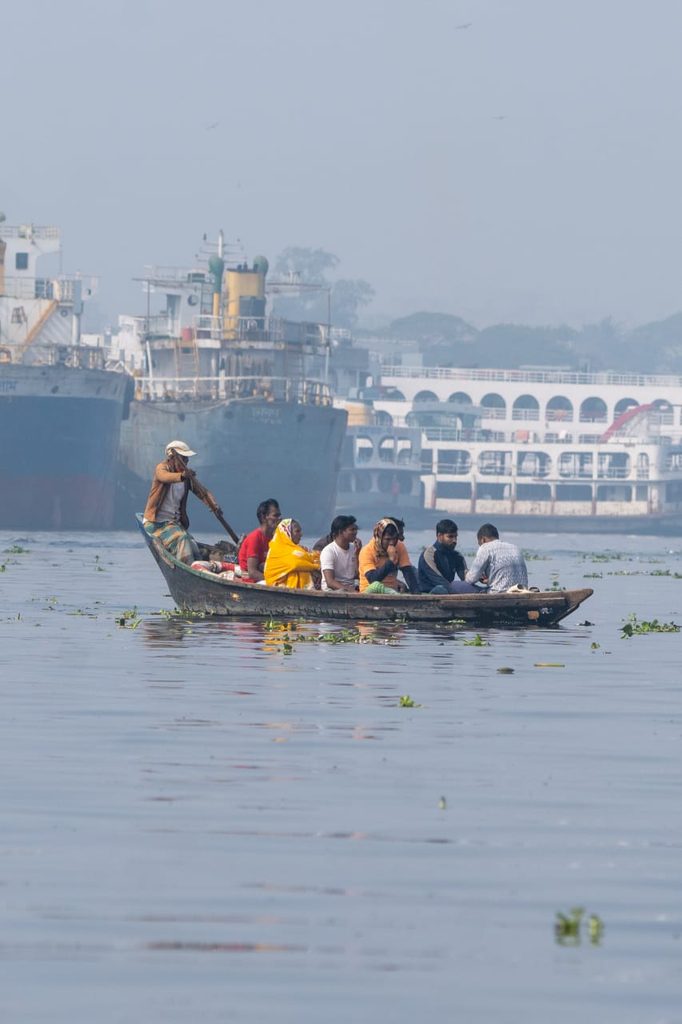
Photo: Courtesy
At the same time, Sumaya and her team collected information on four environmental variables: river depth, boat traffic, water temperature, and dissolved oxygen. They also recorded the locations of river terminals and effluent discharge points.
“For analysis, we calculated encounter rates and used an N-mixture model to estimate population abundance while accounting for imperfect detection. We then used generalised linear mixed models to examine how environmental factors were associated with dolphin occurrence,” Sumaya added.
This combination allowed them to look not only at how many dolphins were present, but at where they concentrated and which habitat factors were associated with their distribution.
Besides river pollution, there are other factors that are creating obstacles to the dolphins’ survival, whereas pollution is only one part of the problem. Their study particularly highlighted boat traffic as an important factor. They found a significant negative association between boat traffic and dolphin occurrence, while river depth had a positive association with their occurrence.
The dolphins are now concentrated in only a few parts of the river, which makes the remaining suitable habitat vital for their survival.
Their research shows that these dolphins are using particular parts of the river, especially deeper areas. This means that conservation cannot focus only on the dolphins themselves, but it also needs to protect the river habitats they depend on.
“For me, the message is very simple: if we want to save the Shushuk, we have to save the river,” concluded Sumaya.