Ahsan Manzil: A son's name on a murdered man's ground
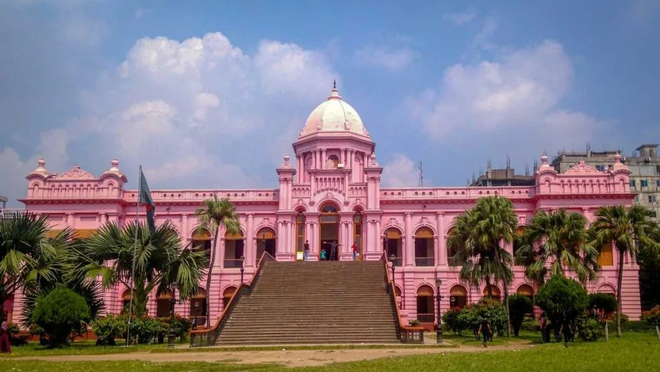
The dome shows first. Long before the building resolves out of the lanes behind the riverfront, there it is above the roofline, octagonal, pale, sitting a little too high over everything around it. It stands about 27 metres off the ground, and for a long stretch of the nineteenth century nothing else in Dhaka was taller.
Almost nobody looking up at it now knows that the ground beneath it was a murdered man’s before it was anyone else’s.
Before the French, before the Nawabs, there was a pleasure house here. It belonged to Sheikh Enayetullah, zamindar of Jamalpur Pargana, who had bought a large stretch of Kumartuli and folded it into a garden. He built a palace in it and called it Rangmahal, a house of colour, made for entertaining. By the few accounts that survive, he was charming company, which is what people say about a man when his death needs explaining.
He was invited to a party one night and killed in a conspiracy on his way home. A single-domed tomb went up in the north-east corner of the compound and stayed there while everything around it changed hands.
Around 1740, his son Sheikh Motiullah sold the property to the French. This is the same French presence from the last piece, the company that asked Nowazish Mohammad Khan for permission and built its kuthi beside the river. The French did not build on empty ground. They bought a dead man’s house from his heir and put a factory next to it.
The French left in 1757, the year of Plassey. In 1785, the property passed to a tradesman named Champigny, and by one account it returned to French hands in 1801. By then it was a trading house on a river with no empire willing to protect it, which is the condition in which a rich local family buys a riverfront.
In 1830, Khwaja Alimullah bought it. He turned the trading house into a home, adding a stable and a family mosque, the modest additions of a man settling in. The scale came with his son.
Thirteen years of building
Khwaja Abdul Ghani began in 1859. He hired Martin and Company, a European engineering firm, and the work ran until 1872. The new building took the name Rangmahal. The older house, where the family had lived since 1830, became the Andar Mahal, the inner quarters. The whole estate he named Ahsan Manzil, after his son Ahsanullah.
Stand on the river side and the first thing you see is the stairway. It climbs from the front of the building to a triple-arched portal, broad enough that you can picture the boats that once pulled up to it. The bricks behind it came from Raniganj. The verandas are recessed in the Mughal way, to keep the heat out, and everything else about the facade is turned towards Europe. It runs about 125 metres along the river, on a platform barely a metre high. Inside, the east wing held the drawing room, card room, library and guest rooms, and the west held the ballroom, dining hall and the family’s living quarters.
It was a house made to be seen from the water.
The evening of 7 April
On the evening of 7 April 1888, a tornado hit Dhaka, and Ahsan Manzil took the worst of it. The Andar Mahal had to be rebuilt almost entirely, and the family left for a time. The Rangmahal needed repairs. Nawab Ahsanullah rebuilt the inner house and, in the work, gave the east wing the dome that identifies it today. The square room on the ground floor was reshaped with brickwork in the corners until it became an octagon, and the octagon became the drum the dome sits on.
The most recognisable feature of the palace exists because a storm took the old inner house away. An earthquake damaged it again on 12 June 1897, and Ahsanullah repaired it again.
In late November that year, Lord Dufferin came to Dhaka as Viceroy of India. The Nawabs wanted to host him at Ahsan Manzil, and in one sense they did. The Dufferins were received at the palace with the pomp a Nawab’s household could manage, and Lady Dufferin wrote about it afterwards. But the ball, the evening everyone would remember, went to Ruplal and Raghunath Das, the two merchant brothers from Farashganj whose house had once belonged to an Armenian.
Seven months after a tornado had torn through the inner house, with the dome barely finished, the Nawabs lost the best night of the decade to a family that had made its money in jute. I think about that every time I look at the dome. The Nawabs spent thirteen years building the answer to exactly this occasion, and the occasion went down the road.
Ahsanullah answered with money, not a rival party. He gave a ward in Lady Dufferin’s name to what became Mitford Hospital, and that outlasted the ball by more than a century.
After the Nawabs
Ahsanullah died in 1901. Khwaja Salimullah became Nawab that year, and Ahsan Manzil became the base for his politics. The All India Muslim League was founded in Dhaka in 1906, and his name is tied to it. A house that began as a place for parties was now where the shape of the next political order was argued over, on marble floors, by men who had come by boat.
The decline came later and quietly, as the family’s fortunes changed. In 1985, the Government of Bangladesh bought the palace and its grounds, and a restoration ran until 1992. On 20 September that year, it opened as a museum. More than 4,000 objects are displayed across 23 of the 31 rooms in the Rangmahal, nine of them laid out to match photographs taken in 1904.
You pay at the gate and walk in. The furniture is where the 1904 photographs say it was, and the portraits look down on visitors reading captions. The restoration is careful, even tender. The stairway on the river side still climbs to the same portal.
The tomb in the north-east corner fell into ruin in the early twentieth century. The name Rangmahal, which some accounts trace to Sheikh Enayetullah, is still the name of the east wing. When I left, I walked back towards Farashganj through the lanes, and the dome was the last thing to drop below the roofline.
But Ahsan Manzil was not the only place in this part of Dhaka where people came to be seen. A little farther from the river, another kind of Dhaka was taking shape, one made not of palaces and marble, but of paper, ink, arguments and names. The books were being printed in Bangla Bazar, and somewhere nearby, writers, poets and journalists were gathering around tables at a boarding house that would become almost as famous as the people who sat in it. I went looking for that Dhaka next.