Figuring out life with 3.2% GDP growth
The year was 1988, papa had just lost my grandpa a few years back, and it must have felt like the weight of the world crashing down on him. Being a 20 something graduate having to support my grandma, siblings, and a hope to build one’s life, Bangladesh could offer little to my father.
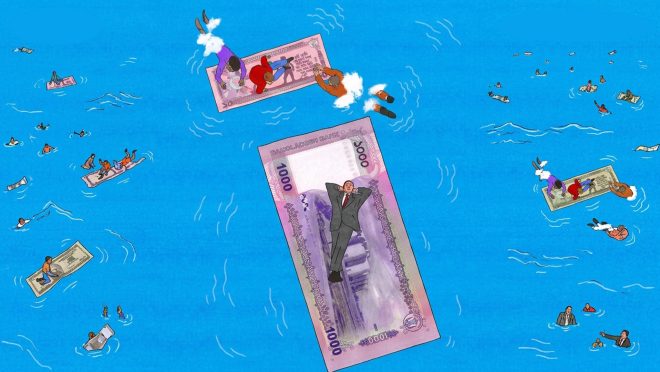
Back then, the country was one of the world’s slowest growing economies at 3.2% GDP growth, and in the coming years, through ups and downs we’re right back where we started as the IMF predicted the same 3.2% GDP growth for FY2027, the question then arises again, will Bangladesh fight back? And can I overcome just as papa did and build a life in this country?
GDP growth measures the growth of the whole economy, not the growth of each person’s income, so maybe I’ll get lucky and win the lottery somehow or marry someone richer. However, if those options are not available, I along with other young professionals are in for a fight.
Papa’s future too didn’t look so bright. He was facing a stagnant economy coupled with 7.4% inflation, according to IMF Staff Country Reports, 1995(018). Bangladesh was still a country relying on aid of 40 thousand metric tons of rice, and it imported 926 thousands metric tons of fuel with petrol being Tk13.86 per litre.
In 2026, fortunately the aid dependent food consumption is completely nil. But you can’t hope to buy anything worthwhile with Tk13. Things change and the economy has grown, papa counted his first salaries in the hundreds while I count mine in thousands. However, the future for me also looks gloomy as well.
In the upcoming FY27 the IMF predicts inflation to be at 10.9%, meaning as my salaries experience that miniscule growth as with all of our private sector salaries, the cost of living will outpace it no matter what, and it won’t matter by how many thousands I expand my earnings, if predictions are to be believed, my five figure salary will not be enough to get a hold of the four figure increases of the cost of living.
Therefore, I, while employed, still might have a few years incoming where it is bound to get harder, no way around it.
Papa faced quite the similar predicament, compounded upon by the continued stagnation due the devastating flood in August of 1988, and according to a World Bank estimate, the floods submerged 84% of the country’s land area and directly affected 45 million people.
What does history tell us then? How did Bangladesh bounce back from the devastating late 80s and emerge as what many have tried to call a success story?
Firstly, various reforms meant opening up industry, especially in the garment sector. Net exports of the country quickly grew and a large number of the population found employment in the middle east, resulting in the influx of remittance and the eventual growth of the reserves.
A witness to such a growth was also my father. He somehow landed a job as an accountant at a very small company in Jatrabari which imported and manufactured water filtration chemicals.
Policies such as the bonded warehouse and reduction on import duties reduced the production cost of ready-made garment drastically, and indirectly this benefitted my father’s small company as well.
The firm would make water purifying plants and supply jars of purified water to local businesses. Very soon after I was born, my father decided he learned what he needed to learn in the business of water filtration, and the accountant quit his job, and started his own business of manufacturing water treatment plants.
“It’s impossible for me to be a salaried employee, I would much rather beg for a living,” he would jokingly boast loudly to me. Little did he realise the confidence confounded in him was also being resonated throughout the whole economy gradually.
Papa may not have made millions, but did what he needed to do to raise me comfortably, put me through an overrated “top school” in Dhaka and pay for my education.
Throughout this whole time, Bangladesh kept growing, and experienced its highest GDP growth in FY2018-19, although the numbers reported at that time might have been inflated as suspected by various experts.
Still, it was evident that the average entrepreneur bounced back and so did this country. But Bangladesh never had dealt with the skeletons inside its very dark closet. Political turmoil, institutional irregularities, politicisation of key state functionaries meant the benefits of this growth was largely experienced by very few, and the dwindling nature of such a one-sided export oriented growth economy got exposed due to the conflicts internationally.
This is where Papa’s predicament may differ from mine. He had the 90s to build himself as did the country. Largely stabilised by the US$475 million loans granted by the IMF, Bangladesh’s economy got the breathing space it so desperately needed after 1988. Along with another US$150 million in 1992 from the World Bank, the country kept on moving.
This time however, the IMF isn’t budging so easily. It repeatedly wants us to reduce the subsidy on farmers’ fertilizers, on fuels and the reforms it asks are far more politically compromising than it had been in the 90s.
The financial reforms it seems are far from being an immediate concern as the govt seems to be treating it as a bargaining chip. On top of that, to what logic I fail to understand, the spending of the govt on its bureaucracy and its social projects are surging by the day.
Private sector credit growth fell to a 33-year low of 4.5 percent in June 2026, which means small business like my father’s are non existent today, that means the employment opportunity papa somehow managed in the 90s as an accountant in a small company is no longer a viable option for me, or any young graduate.
What now?
Well, Bangladesh surely needs a breather. It is still in negotiations with the IMF and recent reports tell us that we are seeking $10 billion from the World Bank.
How much debt is safe to take on? Are we equipped to handle the incurring interest rates at such a low tax to GDP ratio? Will our inflation drop with govt spending rising and Bangladesh bank dropping the interest rates to 9.5%?
I seem to find no explanation in any of the analytical articles or interviews of the economists, and despite having some academic background in this subject, I fear to open my mouth as I see the govt not even being asked to address these concerns.
So papa, what should I do?
Should I stick around in this country which doesn’t seem to give me clear answers, while so many of my contemporaries are abandoning ship left and right? Or should I have faith?
Fath in the country that has bounced back before but didn’t seem learn its lesson, faith in the institutions that time and time again face the same issues but don’t have the ability to face the mirror or faith in the civil and military bureaucracy that sucks the blood out of this country directly while the politicians keep serving them more offerings.
I and I’m sure my contemporaries are in a crisis of faith. A faith in the state that has failed us and as the graph shows, will keep failing in the long run.