Impactful social relationships: A smarter investment for Bangladesh’s youth
Impactful social relationships: A smarter investment for Bangladesh’s youth
Young people invest heavily in friendships, conversations and digital connections, but rarely consider what they gain from them. A banker and development researcher argues that purposeful social relationships can help Bangladesh’s youth build skills, confidence and career opportunities.
A young person has 24 hours a day. Once sleep, study and chores are done, much of the remainder goes to other people: in chats, on calls, or in the endless scroll of social media. Where is this time going, and what do young people get in return?
After two decades in development research and banking, one thought keeps returning. Before investing money, we weigh profit, loss and risk. Yet hardly anyone accounts for whom they invest their two most valuable assets, time and attention, in. Lost money can be earned again; lost time never returns.
Consider two university friends, Rakib and Tania, fictional but familiar. Rakib’s evenings pass in long sessions at the tea stall and in front of his phone screen. Tania also enjoys her friends, but her small group meets twice a week to learn something new, a teacher has drawn her into research, and she volunteers regularly. At graduation their certificates are identical, but their experience, confidence and contacts are not. The difference is not talent. It is a relationship.
From this thought I propose a concept for young people, which I call “Impactful Social Relationships”, or ISR.
Why now
The Bangladesh Bureau of Statistics’ Labour Force Survey 2024 shows unemployment among those aged 15 to 29 at 8.07 per cent, more than double the national 3.66 per cent. About 885,000 of the 2.624 million unemployed are graduates, whose jobless rate of 13.54 per cent is the highest by education level. Worse, 20.3 per cent of young people, roughly 8.56 million, are in neither education, employment nor training, known as NEET.
The causes are structural: a limited job market, a skills mismatch, social barriers for women. Solving them is chiefly for the state. But one dimension is rarely discussed: the web of relationships around a young person. Who encourages them, who shows them the path to skills, and who silently drains their time and morale all shape their future. Young people cannot change the market alone, but how they tend their own garden of relationships is entirely their decision.
The same survey finds nearly 36 per cent of job seekers ask relatives and friends for help, one in three. Relationships remain our biggest hope for a job. The question is whether they are about lobbying or about capability. ISR points to the second path: relationships that build ability, not ones that seek recommendations.
What is ISR?
What matters is the impact of relationships, not their number. Five thousand social media friends and five people who stand by you in a crisis are entirely different things. ISR means consciously choosing and nurturing relationships that awaken creativity, advance careers and build skills: ISR = Learning + Creation + Collaboration.
Before giving regular time to any relationship, ask: Am I learning something here? Is something new being created? Am I moving forward? If the answers have long been “no”, rethink it.
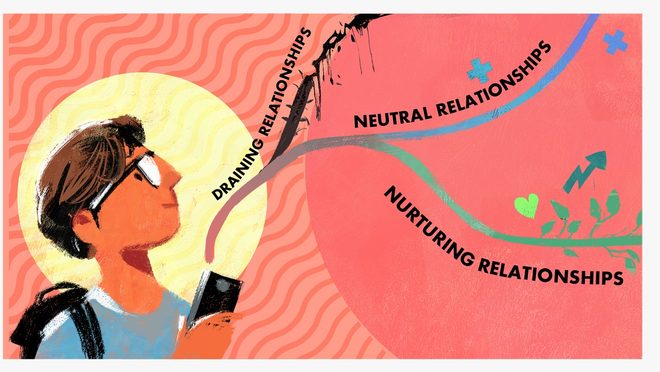
Relationships fall broadly into three kinds: nurturing ones that teach, give courage and open doors; neutral ones that bring joy but little change; and draining ones that take time, money and morale, even harming mental health. ISR aims to grow the first, keep the second moderate and gradually move away from the third. It does not mean using people or putting friendships in a ledger. Chatting and pure enjoyment are part of life; the problem begins when they consume everything and leave only exhaustion, comparison and frustration.
Seven pillars
How does a young person build such relationships? Here are seven pillars.
1. Choose by goal. One who does not know where they want to go cannot tell which relationships are taking them forward. So write down where you want to be in three to five years, then think about who is on that path: which teacher, professional or organisation. Draw your map of relationships along your map of goals.
2. Find a mentor. Japan’s senpai-kohai tradition, a mentoring bond between senior and junior, is long established. Here, young people often hesitate to approach experienced people. Yet in industry-academia work I have seen a good mentor transform a young person’s confidence and direction; a good mentor shortens many years of mistakes. Finding one needs no great formality: a polite email, a specific question or a few minutes after a seminar is enough to begin.
3. Build a growth circle. You gradually become like those you spend most time with. Form a group of five to seven like-minded peers who take courses together, build projects, enter competitions and share ideas for new ventures. Competition in such a group is healthy and success belongs to everyone. Present progress monthly to stay accountable.
4. Account for your time. As a bank balances its books daily, record for one week which relationships took how many hours, and how you felt afterwards. Some will be draining: gossip, negativity, needless quarrels, or ties that repeatedly pull your studies and career backwards. Learn to draw boundaries politely; saying “no” is a skill.
5. Practice digital discipline. The smartphone gives access to the best universities’ courses and also swallows hours in aimless videos. Keep a quality professional profile, join skill-based online communities, control notifications, and set a fixed daily time for learning.
Hi 6. Give. A relationship that only lasts does not last. Help others with your own skills: tutor younger siblings, volunteer, stand by others in disasters. This builds trust and reputation; in interviews, volunteering often speaks louder than a certificate. If you deposit nothing in the bank of relationships, you have nothing to withdraw on the day of need.
7. Hold to family and values. The greatest risk of career-centred thinking is judging relationships only by usefulness. Family and true childhood friends, who stand by us without self-interest, are the foundation of well-being. Without honesty, respect and trust, no relationship stays impactful.
Who should do what
ISR cannot rest on individuals alone. Universities can launch mentorship programmes and use alumni networks. Companies can link young people with experienced professionals through industry-academia partnerships. Parents can talk openly with their children about which relationships matter and why, instead of merely being suspicious. The media can showcase role models who built their place through the right relationships.
Banks can turn school banking and financial literacy programmes into bridges, going beyond opening an account, to career advice, skills training and entrepreneurship support. Singapore has made lifelong skills development a national priority through SkillsFuture since 2015; we too could consider an integrated platform for youth skills and mentorship.
A final word
The window of the demographic dividend will not stay open forever. If this generation invests its time and attention in the right relationships, it will be the country’s most profitable investment. So I ask every young person: look at your list of relationships today. Which is teaching you, which is building you, and which is silently eating your future? When relationships change, habits change; when habits change, the future changes. The right relationships are a young person’s greatest capital.