
How Bhawal’s social forestry is failing the forest and its people
How Bhawal’s social forestry is failing the forest and its people
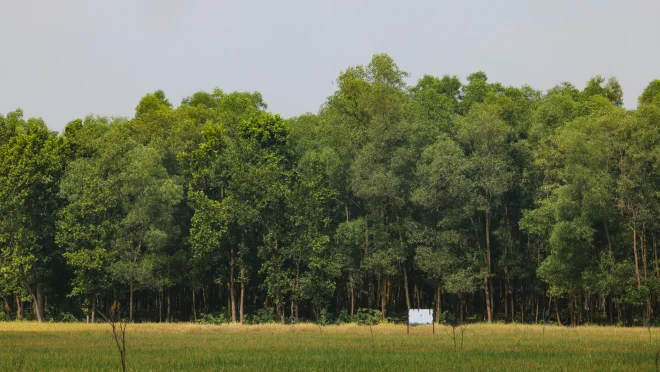
In Bhawal, social forestry has increasingly replaced native Sal woodland with exotic species, threatening the forest’s ecological diversity. Meanwhile, the government programme has largely excluded the local disadvantaged residents it was originally designed to benefit.
We entered the Bhawal Sal forest along the Dhaka–Mymensingh highway, expecting deep greenery, monkeys leaping from one tree to another and, if we were lucky, a glimpse of some wild cats.
From the highway, the forest appeared green. The Sal trees, with their distinctive features, created a sense of mystery. The forest looked lush, hiding a deep secret beneath its canopy.
But the secret turned out to be that much of the forest was not Sal forest at all. A few steps inside, we realised that the trees around us were not Sal; they were Akashmoni (Acacia auriculiformis). Neatly trimmed, well groomed.

Infograph: TBS
The contrast was striking. The Sal woodland seemed to end abruptly, while stretches of Akashmoni lay concealed behind a thin layer of Sal. The Sal was only shielding the Acacia plantation from the eyes of those travelling along the highway.
Judging by the history of land acquisition in the area, our first thought was that influential local landowners had replaced the Sal with Akashmoni, which grows faster and has greater economic value.
However, we were proven wrong. The planting had been carried out under government directives itself.
We met Jagadishchandra Barman, a local farmer working in a jot (privately owned land) who offered an explanation. “These were planted by foresters and local residents six to seven years ago. Every 10 years, the timber is sold, and the proceeds are divided between the government and those who look after the trees,” he said.
This is called social forestry, a programme that began expanding across Bangladesh in the early 1980s. Its original purpose was to restore degraded forestland, involve local communities in protecting and managing forests, and improve the economic conditions of rural people through income-generating activities.
In principle, it was meant to serve both the forest and the people living around it. It works like this: economically disadvantaged people protect the land from deforestation. In return, after a certain rotation period, they earn a share of the proceeds from the timber they helped produce.
On paper, it looks like a very good idea. But the sight raised some obvious questions: How much of the Sal forest has actually been replaced by exotic tree species? How much has this altered the ecosystem, and has it really benefited the people living around it?

Once, tigers and bears used to roar in the forest, but now even monkeys are rarely seen.
A forest losing its identity
Jagadishchandra Barman, 70, belongs to the Koch community. Drawing on his life experience and the stories passed down by his ancestors, he gave us an idea of what the forest looked like when he was growing up compared with what it looks like today.
“All of the lands that you see here today were Sal trees. We have heard tigers and bears roaring where you are standing.” said Jagadish.
“Now, even monkeys rarely come here. Some wild cats can be spotted occasionally, but that’s about it. Even birds are rare these days.” he added.
His description is not mere nostalgia. Experts back up his statement.
Mohammad Zashim Uddin, Professor of Botany at the University of Dhaka, believes, when diverse native woodland is replaced by dense, single-species plantations, the variety of plants, insects and habitats available to wildlife can decline.
“Native animals have a relationship with native plant species, each animal has specific preferences of trees in terms of habitat,” he said.
“These relationships were built over thousands of years, when those trees are replaced with foreign plants, they lose their habitat. The biggest problem is that these plantations are destroying our local ecological heritage. They are replacing native trees and disrupting the balance of the ecosystem,” he added.
The problem with Akashmoni is that it is native to Australia and parts of the Asia-Pacific region. It was introduced to Bangladesh because of its fast growth and commercial value. However, Bangladeshi soil, particularly the ecosystem of Bhawal, is not suitable for Akashmoni plantations.
When planted extensively, it can put pressure on local water resources, particularly during dry seasons. There are concerns that large plantations lower groundwater levels and crowd out native trees, making it harder for them to regenerate. As a result, the forest loses its diversity, leaving fewer plant and insect species and fewer habitats to support wildlife.
The shift is clear in the land-use figures. A 2023 study by Md Shamim Hossain, Asib Ahmed and Anik Ahmed, published in the Ecology journal, found that Sal forest accounted for 44.02% of Bhawal National Park in 1995, while plantations covered 5.88%. By 2023, the share of Sal forest had fallen to 22.54%, while plantation cover had risen to 40.2%.
According to the forest department’s official records, the land area under the social forestry program encompasses around 52 acres in Bhawal. Most of which is covered by Akashmoni trees.
The forest has been systematically stripped of its natural ecosystem. Now, much of it that remains is actually mimicking the forest it has replaced to become more economically productive.
Who benefits from social forestry?
We looked around for people who were part of the social forestry scheme. Most of the people living in the area belonged to the Koch community, an indigenous community whose members say their ancestors were brought from Koch Bihar by the British to help protect the forest.
Surprisingly, most of the Koch families we spoke to had little to no involvement in the social forestry programme.
“We do not get the opportunity to take part in the programme. All these lands are allocated to politically influential people,” said Sadhin Koch.

Native to Australia and parts of the Asia-Pacific region, Akashmoni was introduced to Bangladesh because of its fast growth and commercial value.
During our visit, we found only one Koch family that had been selected to participate in the programme. But the Social Forestry Rules, 2026, set out a different picture of who should receive priority.
According to the rules, the selection committee must prioritise local residents living within one kilometre of the designated land who belong to disadvantaged groups. These include landless people or those owning less than 50 decimals of land; widows; abandoned and distressed women; distressed members of ethnic minority communities; insolvent persons with disabilities; and other disadvantaged and marginalised residents.
The rules also state that a local participant cannot be included in more than one social forestry agreement.
The Koch family looking after the strip of land we visited was allocated one acre. Other plots, according to local residents, went to people with political influence. They also alleged that the same family had control over multiple plots — a claim that raises further questions about how the department selected participants and enforced the rules.
The provisions raise an obvious question: if disadvantaged ethnic communities are among those who should receive priority, why have so few Koch families in the area been included in the programme?
“From my understanding, we need people who are capable enough to defend the land. That’s why weak people are not given any land,” explained Ariful Islam, the local range officer.
Once the trees are harvested, the proceeds are split between the government and those who looked after the plots. Forest Department records show what this has actually amounted to. Over three financial years — 2019-20, 2020-21 and 2021-22 — the department recorded Tk1.08 crore in revenue from social forestry plantations in Bhawal.
Forest Department records show that 68 people are currently participating in the programme. However, the department has not disclosed the names of the participants or how much revenue has been distributed among them.
Can Bhawal’s Sal forest return?
A letter issued on 23 November 2024 instructed officials to stop producing and planting Akashmoni saplings in its nurseries. The Forest and Tree Conservation Act, 2026, also calls for prioritising native species and avoiding invasive ones in afforestation programmes.
But the existing plantations are still there. According to Rashed Arif, Assistant Conservator of Forests (ACF) in Bhawal, no new Akashmoni has been planted since 2024. The existing trees, however, will remain until they are ready for harvesting. The process was temporarily suspended in 2025 amid administrative changes, he said, and is now expected to resume.
So what happens after the trees are cut down? Will the department bring back Sal, or replace Akashmoni with another commercially valuable species?
“Akashmoni will not be planted again. We will select the species suitable for the area,” Rashed said.
He did not specify which species would be planted or whether there was a plan to restore the native Sal woodland.
However, stopping Akashmoni planting is only the first step. The department must now show that the next phase of social forestry will restore more than just tree cover and deliver on its promise to the people living alongside the forest.