Ctg Uni set for first TSC in 60 years with Tk49cr project
Ctg Uni set for first TSC in 60 years with Tk49cr project
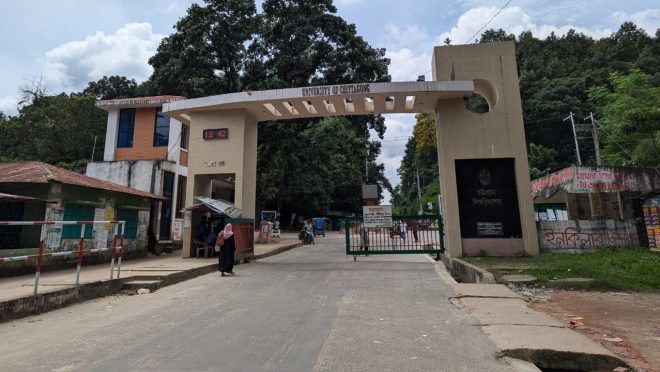
For the first time since Chittagong University (CU) was established in 1966, a central Teacher-Student Centre (TSC) is set to be built on its campus, with a government-funded project worth Tk49.33 crore now awaiting final approval.
The proposed five-storey Chittagong University TSC aims to address a long-standing demand for a common space where teachers, students and researchers can access academic and daily services, and take part in intellectual and cultural activities.
According to Planning Commission and University Grants Commission (UGC) sources, the Development Project Proposal, titled “Construction of Chittagong University Teacher-Student Centre”, is in the final stage of approval.
Located in Hathazari, around 22km north of Chittagong city, CU has long faced difficulties in providing students and teachers with access to textbooks, reference books, research journals, and other academic materials.
Because of the campus’ distance from the city, many have to travel there to obtain these resources.
The proposed centre, to be built beside the university’s central Shaheed Minar, is intended to reduce this dependence by bringing academic resources and essential services onto the campus.
It will also provide an integrated space for academic discussions, seminars, workshops, and cultural activities.
What the centre will offer
The five-storey building will cover 10,480 square metres and include bookstores, facilities for collecting academic books and research materials, a modern digital library, reading rooms and study spaces.
It will also house convenience stores, ATM booths, printing and photocopying services, cafeterias and restaurants.
Lecture halls and other facilities will be available for seminars, workshops, academic discussions, and cultural programmes.
To improve accessibility, the building will have ramps, accessible lifts and adapted restrooms for persons with special needs. Lactation rooms and prayer rooms are also planned.
Other facilities will include solar power systems, a 200 kVA generator, two passenger lifts and fire safety systems.
According to the project proposal, CU has 26,678 students and 1,010 teachers across its 2,312.32-acre campus.
The university needs further expansion of academic facilities to support its students and researchers.
The project is expected to strengthen academic interaction, research and intellectual activities while improving access to learning resources.
The proposal also says the centre will help the university produce graduates and researchers equipped with modern science and technology-based knowledge and develop skilled human resources for a competitive global environment.
Of the total estimated cost of Tk49.33 crore, Tk43 crore has been proposed for building construction.
2,000 people to receive services daily
The project’s logical framework estimates that around 2,000 teachers, students and researchers will receive services from the centre each day once it becomes operational.
It also sets a target of reducing dependence on Chittagong city by 50% for obtaining educational materials and research journals.
The project is scheduled for completion by 30 June 2029.
CU Vice-Chancellor Professor Dr Mohammad Al-Forkan said the initiative addressed a long-standing demand from students and would expand academic facilities for teachers, students, researchers and alumni.
“Being far from the city, our students face a shortage of necessary learning materials and reference books. Besides, infrastructure for mutual understanding between teachers and students outside the classroom as well as healthy cultural activities was insufficient on campus,” he said.
Once completed, the centre would expand academic and research opportunities and reduce the need for students and teachers to travel to the city, he added.
Planning Commission sources said the project had completed verification and screening and was awaiting final approval.
As its cost is below Tk50 crore, the planning minister will approve it under the applicable rules. Final approval is expected within this month.
A Project Evaluation Committee meeting on the proposal was held on 19 July. Following the meeting, the DPP was revised in line with the committee’s decisions and recently resubmitted to the Planning Commission.