DU student launches Streamium to bring multiple AI models under one subscription
DU student launches Streamium to bring multiple AI models under one subscription
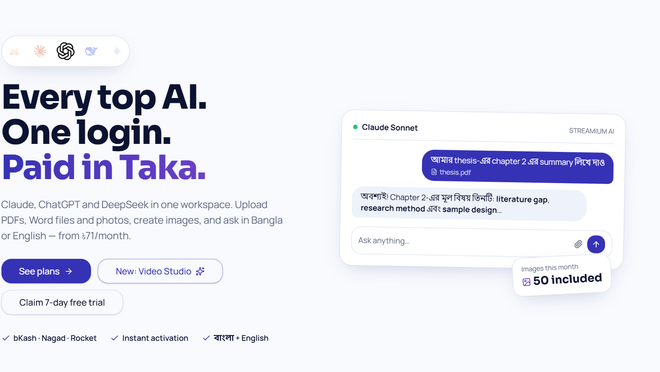
A University of Dhaka student has developed Streamium, a multi-AI platform designed to give users access to various artificial intelligence models and creative tools through a single workspace, with local payment options including bKash.
Created by Tanvir Chowdhury, a master’s student in the Department of Chinese Language and Culture, the platform aims to address the challenges of managing multiple AI subscriptions, particularly for students and professionals in Bangladesh who may not have access to international payment cards.
Streamium brings together AI models from providers including OpenAI, Anthropic, Google and DeepSeek. According to Tanvir, users can access models for research, coding, writing and other tasks, alongside tools for image and video generation.
The platform also features a creative studio offering video-generation tools such as Hailuo, Kling and Seedance, as well as image-generation capabilities. Other features include voice typing and the ability to run code directly within chat.
Tanvir said his experience providing digital subscription services under the Streamium name helped him recognise the difficulties Bangladeshi students faced in accessing different AI tools. He subsequently decided to develop a platform that would bring these services together.
“To be honest, being a student right now in Bangladesh is the whole reason STREAMIUM exists,” he said.
“When you’re sitting in a dorm or library at 2am trying to debug code or finish a research assignment, and you don’t have an international credit card to pay for Claude or ChatGPT, you don’t just see a business problem, you feel the frustration firsthand.”
Tanvir said he spent weeks integrating application programming interfaces (APIs), developing the platform’s interface and incorporating a local payment gateway to enable payments through bKash.
Addressing questions about the platform’s legality, Tanvir said Streamium uses official developer endpoints and pays providers based on computing usage.
“Every time someone asks Streamium a question, our backend legally calls the official developer endpoint, pays wholesale per compute unit, and delivers the answer back to the user,” he said.
He compared the model to streaming services that distribute content through agreements with rights holders and ride-sharing platforms that use mapping services.
While platforms such as Poe and Perplexity already offer access to multiple AI tools, Tanvir said Streamium aims to distinguish itself in the Bangladeshi market through access to newer models, privacy features, document-generation tools and local payment facilities.
The platform is currently being refined based on user feedback, with Tanvir seeking to make its features more accessible and user-friendly.