
JU hosts 16th Butterfly Fair to promote biodiversity conservation
JU hosts 16th Butterfly Fair to promote biodiversity conservation
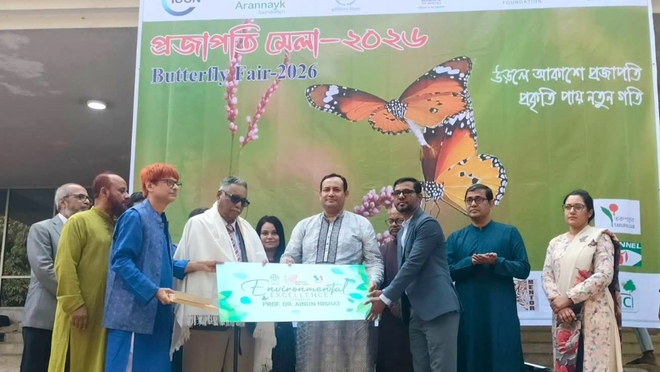
Jahangirnagar University (JU) hosted its 16th Butterfly Fair on Friday (28 November), bringing together students, visitors and nature enthusiasts to promote butterfly conservation and raise awareness about biodiversity.
Organised by the Entomology Section of the Department of Zoology, the daylong event was held on the premises of the university’s Zahir Raihan Auditorium, featuring an inaugural ceremony, award presentation, book unveiling and various activities.
Professor Dr Ainun Nishat of BRAC University received the ‘Butterfly Award–2026’ for his contributions to environmental and climate protection. Nabila Zaman Jyoti, a student of the Department of Zoology at Dhaka University, received the ‘Butterfly Young Enthusiast–2026’ award for her contributions to wildlife research.
The fair also featured the unveiling of a book titled Larval Host Plants of Butterflies in Bangladesh. It contains larval photographs of 50 butterfly species, descriptions of their host plants, information on adult butterfly biology and genetic data to help identify species.
In the photography competition, Arunabho Bruno secured first place, followed by Masuk Ahmed in second and Iqbal H Babu in third. Media awards were also presented in broadcast, print and digital categories for contributions to wildlife conservation through journalism.
Visitors took part in a range of activities, including a rally, puppet show, origami exhibition, children’s drawing and quiz competitions, butterfly-shaped kite flying, a debate competition, a butterfly identification contest and documentary screenings.
Addressing the inaugural ceremony, JU Vice-Chancellor Professor Dr Md Nurul Islam called for an end to unplanned tree felling in the name of development. He pledged that no unplanned tree cutting would be allowed on campus during his tenure.
He stressed that nature conservation requires both institutional commitment and individual responsibility, expressing his vision of a greener campus where butterflies could move freely among flowers and trees in their natural habitats rather than being kept inside artificial nets.