A National Award, a forest, and a mission: Mahfuz Russel’s mission to protect Bangladesh’s forests
In an era when only having a lucrative conventional career defines success, few choose to walk away from comfort in pursuit of a greater purpose.
A National Award, a forest, and a mission: Mahfuz Russel’s mission to protect Bangladesh’s forests
In an era when only having a lucrative conventional career defines success, few choose to walk away from comfort in pursuit of a greater purpose.
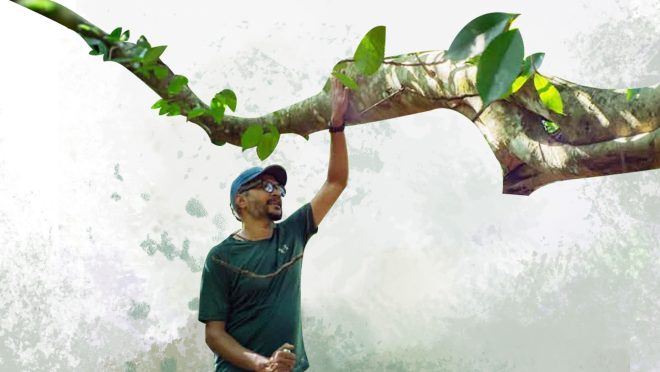
Mahfuz Russel did exactly that. Leaving behind a promising career in Manchester, United Kingdom, he returned to Bangladesh and immersed himself in the forests of Khagrachari, dedicating his life to protecting biodiversity and advocating for environmental justice.
His work has led to a National Award for tree-related research and conservation. His privately developed Pitachhara Forest was recognised as a successful community-based conservation model, integrating forest restoration, wildlife protection, education, healthcare, and research.
To know more, I talked with him about his whole transition, both personally and professionally.
Bangladesh’s development model is sacrificing nature for short-term economic gains. Bangladesh has achieved impressive development, but in many cases, nature has paid the price. Mahfuz’s view is simple: in any development process, the environment and biodiversity should be the first priority. True progress is development that protects nature while improving people’s lives.
Many times, Mahfuz had to oppose influential individuals or institutions to protect a forest ecosystem. Protecting nature often means standing up to powerful interests.
“I have publicly challenged PRAN Group and Rahman Chemical over the large-scale expansion of cassava plantations in the Chattogram Hill Tracts, which media investigations found had replaced thousands of acres of natural forest and threatened biodiversity. My advocacy helped bring national attention to the issue and sparked wider public debate and protests,” he said.
He also opposed illegal loggers, poachers, and other local groups involved in forest destruction. In 2023, Mahfuz was violently attacked and threatened with death while trying to stop wildlife hunting in Khagrachari. Despite that, he continued his work because conservation requires courage.
“If we remain silent in the face of powerful interests, we will lose our forests, wildlife, and ultimately our future.”
If conservation work paid as much as a corporate career, many young Bangladeshis would join the sector, he believes. Youngsters here are passionate about nature, wildlife, and environmental issues, but conservation is often seen as a low-paying and uncertain career path. If conservation work offered salaries and career opportunities comparable to the corporate sector, Mahfuz believes many more talented young people would join. Protecting nature is not just a passion, it is essential work for the country’s future, and it should be valued accordingly.
Upon being asked what inspired him to choose forest work after leaving his corporate life in Manchester, he termed that a common misconception.
“I didn’t leave Manchester and return to Bangladesh because I had planned a career in conservation. I came back after my father passed away because I wanted to be closer to my mother.”
Living in the Chattogram Hill Tracts, he witnessed the rapid loss of forests, wildlife, and biodiversity firsthand. Over time, he felt a responsibility to act, and that is how conservation became a major part of his life.
In the short term, conservation can sometimes appear to limit economic opportunities. But when conservation is well planned and local communities are actively involved, it creates a much stronger foundation for long-term growth.
A practical example is tourism. If a natural forest is cleared for short-term profit, the economic benefits may last only a few years. But if the forest is protected and managed sustainably, it can support tourism, local businesses, jobs, clean water, and other ecosystem services for generations. It may seem slower at first, but it creates more resilient and sustainable economic growth.
The real choice is not between conservation and development. It is between short-term gains and long-term prosperity.
Talking about policy, it is difficult to identify just one policy failure because several systemic issues continue to undermine forest conservation in Bangladesh.
First, forests are still largely treated as the sole responsibility of the Forest Department. In reality, biodiversity conservation requires the involvement and accountability of all government agencies, including law enforcement, local administration, land management authorities, and development agencies.
Second, forest governance remains too centralised. Local communities, private landowners, and civil society should have a much greater role in protecting and managing natural resources.
Most importantly, environmental protection and biodiversity conservation should not be confined to a single ministry. They should be a core consideration in the policies and decisions of every ministry. Unless nature is integrated into all development planning, forests will continue to face pressure despite growing public awareness.
“If I had to choose one most important point, I would choose: environmental protection and biodiversity conservation should be a core policy consideration for every ministry, not just the Forest Department or Ministry of Environment.”
Because many threats to forests, including roads, energy projects, agriculture, mining, land allocation, and industrial development, originate outside the Forest Department, forest conservation will remain difficult unless all government institutions share responsibility for protecting nature.
Environmental activism has become more dependent on social media, but that is not necessarily a bad thing. Social media has helped create environmental awareness across Bangladesh and has given many important issues national attention.
The biggest misunderstanding is that people often see forests only as resources to be used, rather than ecosystems that support biodiversity, water, climate stability, and human livelihoods.
This is not just a Khagrachari issue. It exists across Bangladesh. Both indigenous and Bengali communities can put pressure on wildlife through hunting and other activities. The real challenge is that many people still do not fully understand the value of biodiversity and the essential role forests play in our future.
When asked that if all the current projects disappeared tomorrow, what would be the first thing he would rebuild, he said he would probably return to living more quietly in nature.
“These days, the demands of conservation work leave me with far less time to enjoy the forests and wildlife that inspired me in the first place.”
Before rebuilding any project, Mahfuz would rebuild that connection with nature because it is the foundation of everything he does.
Looking back, Manchester taught Mahfuz something that goes beyond conservation. During his career spanning over 14 years in the UK, he travelled widely, lived briefly in different places, met extraordinary people, and experienced nature in many forms. It was a journey of learning about the shared human experience and our connection to the natural world.
Those experiences fulfilled a personal quest for understanding and gave him a strong sense of self-reliance and sustainability. They taught him to stay curious, to listen before judging, and to recognise that despite our differences, people everywhere share many of the same hopes and challenges.
“Those lessons shape how I approach conservation and community engagement today.”
When history remembers his work, he found it difficult to answer when asked what he hoped it would remember beyond the awards and recognition. But if there is one thing Mahfuz hopes people remember, it is that he tried to be empathetic toward nature and that he worked to bridge the gap between field experience and science.
On receiving the National Award, he sees it less as a personal achievement and more as a tool that he hopes will help his work progress further.
“Recognition opens doors, builds trust, and gives greater visibility to conservation issues,” concluded Mahfuz.