What it takes to thrive beyond the classroom: In conversation with Sayeda Tahya Hossain, Chief HRO, Grameenphone Ltd
As artificial intelligence, digital transformation, and rapid technological advancement continue to reshape the global job market, the traditional idea of building a career solely based on academic qualifications or grades is gradually losing its dominance and trust.
What it takes to thrive beyond the classroom: In conversation with Sayeda Tahya Hossain, Chief HRO, Grameenphone Ltd
As artificial intelligence, digital transformation, and rapid technological advancement continue to reshape the global job market, the traditional idea of building a career solely based on academic qualifications or grades is gradually losing its dominance and trust.
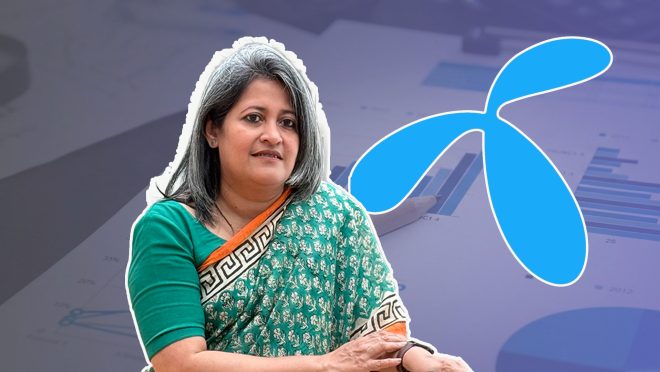
For students and young professionals seeking to enter Bangladesh’s rapidly evolving telecommunications sector, the ability to adapt, learn continuously, and understand the emerging global world, whose foundation is based on technology, may now matter as much as, or even more than, the degree written on their certificates.
Sayeda Tahya Hossain, Chief Human Resources Officer of Grameenphone Ltd., believes that the future of employment will increasingly depend on how effectively individuals respond to change.
With over 25 years of experience in human resources, she has held senior HR leadership roles at some of the country’s and region’s most prominent organisations.
I had the opportunity to hear from her regarding the skills our youths actually need to sustain in the competitive job market in the era injected beyond CGPA.
Reflecting on her own upbringing, she emphasised the role of on-the-job learning.
“I was fortunate to begin my career at Nestle. Most of what I learned, I learned on the job. Of course, I studied human resources as a subject during my B. Com degree, but it was only in one subject. At that time, HR was not even a major. So, most of my education came from the workplace.”
Academic qualifications may open the door, but adaptability, curiosity, resilience, and the willingness to continuously develop oneself may determine how far one can go. As the telecommunications industry moves beyond traditional voice communication towards data, digital services, and AI-driven innovation, the question for young minds is no longer simply what they have studied, but how prepared they are to learn what the future demands.
Knowing the market
“We are going through a transition where we need to develop many new skills. Digital development is certainly important, and AI-related skills are also emerging as a new necessity.”
For these dynamics, conglomerates are not necessarily checking someone’s academic background. They are simply trying to understand how much the person knows about the changes that are taking place, which is more significant.
To apply for a job in any industry, whether it’s telecommunications or other, firstly, candidates need to understand what is happening within the organisation and across the respective industry.
“When someone comes for an interview, we assess what changes are happening in the industry, what Grameenphone is doing, and how much the candidate knows about Grameenphone. We don’t only evaluate academic qualifications because those alone aren’t enough to qualify someone for everything.”
Applicants’ willingness to learn is also extremely important, especially in fields like Grameenphone.
“Whenever we advertise for internships, we receive a huge number of CVs. At the initial stage, we may have to look at CGPA or similar qualifications to shortlist candidates. But after that, these other factors are much more important.”
Grameenphone looks at whether the internship applicants show genuine interest and possess the thought that, ‘during these few months, I will actually work as part of Grameenphone’s workforce.’
Talking about applicants, Sayeda said they receive many excellent students. Sometimes, it becomes difficult to let them go when the tenure is finished because they take such ownership of their work that Grameenphone starts wondering who will take over after they leave.
“During those three or four months, we become accustomed to them handling those responsibilities.”
Today’s youths are not confined to 9-5 jobs. They love to explore, they love to unleash their potential beyond barriers. As such, career shifting has become commonplace. While talking on this bar, career changes are a very normal and natural part of today’s world, as believed by Sayeda.
“I am sure that at Grameenphone, we have often seen people doing volunteer work, and we have selected individuals based on that experience. Why are they selected? Not simply because of their academic background, but they are selected based on their contribution, their interest, and the kind of activities they are passionate about.”
Finding the right fit
In Curriculum Vitae (CV), only academic grades are not important. Extracurricular activities also have their intended place. How much community work one has done, how much volunteering a candidate has participated in, how much he or she has been involved in different projects outside of formal education, and what they contributed through those activities are all indicators of a candidate’s competence.
“We try to assess these things because they are more important to us than simply looking at numbers in the grade sheet.”
Some come to the board visibly nervous, while others exhibit an aura of self-confidence and a belief in his or her ability.
“Being nervous is normal. That is why we try to break the ice first rather than immediately asking questions. It is our responsibility to make candidates feel more comfortable when they are responding to the questions we ask.”
This applies when interviewing senior leaders as well as when interviewing junior candidates. Making the interviewee comfortable is more the responsibility of the interviewer than the interviewee.
Joining a corporate office and understanding the working environment of the office is challenging, especially for those who are new and don’t have any prior experience.
Sayeda Tahya Hossain urged the candidates beforehand to learn about the organisation. That is the most important thing. Interns and even freshers should gather knowledge about what is happening in the organisation, what has happened in the past, and what may happen in the future during those three or four months.
Oftentimes, there is a notion heard around the industry that working with Gen Z is difficult.
In response to this ‘accusation’, Sayeda Tahya Hossain explained that GP never thinks in such terms.
“Change is now constant. Every day, a new change is taking place. What we need to see is how well they can adapt to change.”
According to Sayeda Tahya Hossain, a student should embody a sense of understanding. Whether that person belongs to Gen Z or Gen Alpha does not matter. They must have the ability to adapt and move along with the organisation. That is the resilience part.
“During our time, we did not have access to the same technological advancements which Gen Z has today. They are much more advanced technologically than we are.”
The role of AI in Grameenphone
“From what we currently understand about the influence of AI on organisations and businesses is that people initially said AI would destroy jobs and lead to massive job cuts. But we do not necessarily see it that way now.”
According to Sayeda Tahya Hossain, it seems to be more about how much advantage one can gain by treating AI as a partner. AI can make organisations more efficient, improve data analytics, and make decision-making more accurate. In these areas, AI will bring many positive things to organisations.
But she acknowledges that some roles may be eliminated because AI can perform those tasks. But hundreds of other roles may be created.
“Everything is about change. As long as I can accept that change is a constant and that, for as long as I want to work, I will have to go through changes, I will be able to develop and equip myself to adapt to those changes”, said Sayeda.
A reflection on business degrees
There has traditionally been a belief that corporate offices, whether in telecommunications or other industries, mainly hire BBA graduates in fields such as marketing or finance.
And encompassing this belief is the question of choosing one’s major, whether it be in finance, marketing, accounting or HR.
Sayeda’s point of view on this regard is that it depends on what type of role a student is applying for. One cannot apply for every role with a sociology degree; similarly, one cannot apply for every role even if he or she has studied BBA or MBA. It depends on what he or she wants to do in life.
“Your education should be based on that, and your role should also be chosen based on that.”
Every organisation has different types of roles. It is not always about IT, Engineers, or BBA and MBA graduates. There is no single specific degree that guarantees opportunities. However, one needs to understand which qualifications are relevant to which roles. That is important.
Sayeda Tahya Hossain added that students now need to become more equipped.
“We at Grameenphone are continuously equipping ourselves. Through Grameenphone Academy, we have an institution where university students can gain future skills. We try to develop them with various skills and provide certifications in different areas so that they can also become prepared.”
The corporate landscape
In recent years, there have been controversies surrounding the current working culture. There have been organisations pushing their employees to work beyond the office schedule and malpractices are being reported.
Sayeda Tahya Hossain has a pragmatic outlook in this regard.
“As far as I understand it, as a leader, when we say that you should give your time, we mean that you should give yourself wholeheartedly during the eight hours that you are working. Give it your full effort so that you can contribute to your own growth as well as the growth of the organisation.”
Work-life balance is important. People’s priorities change at different stages of life.
“When you continue contributing and enjoy your work, you will naturally find yourself thinking about it.”
As she mentioned in a comical anecdote, even after 30 years, she is still thinking about work 24/7. While she is cooking for her family, and as she is serving food at the table, her work continues to run through her mind.
The mindset
People are the ones who move an organisation forward. Therefore, it is imperative to understand people one works with.
Listening is the first of that mindset.
In terms of communication skills, the first thing is whether the other person is receiving and interpreting the message correctly in the way it should be intended to communicate.
If someone is unable to communicate the information they are trying to share properly to the person they are talking to, then communication has not actually taken place.
“It is not about how well you speak English or Bengali. That does not make any difference. If you cannot make the other person understand what you are actually trying to communicate, then effective communication has not happened.”
According to her, a person must remain open to learning. Secondly, they must have resilience and patience, and hard work is a must.
A helping mindset, understanding others, and collaboration are all extremely important things to keep in mind when someone enters a job. One cannot do anything completely alone.
“I always say that wherever you go, you must keep learning. You must keep learning because what you can learn on the job can never be fully learned from academic books.”
In every experience, Sayeda Tahya Hossain has learned something new, not limited to understanding HR. It is about learning something new from every experience.
Speaking of Grameenphone’s culture, one major factor is the ‘values’ that Grameenphone carries, which are trust, curiosity, and passion. These values are also demonstrated outside the organisation.
There must be openness and trust within the organisation so that people can speak openly, ask questions, learn, and gather knowledge. Then there is curiosity: curiosity about what is new and what can be done differently. Grameenphone tries to maintain a culture of continuous innovation.
And then there is passion: loving the job, loving what we do, and loving the organisation.
“We try to deeply embed these three elements into our culture, and we demonstrate them outside the organisation as well.”
The same applies when they conduct social work under ESG initiatives. They try to demonstrate the same values there as well.
“We do not try to be different when we go outside. We want to remain the same organisation that we are internally, so that people outside can see the same culture. We believe that we have one of the best organisational cultures among the top organisations in Bangladesh.”
She feels privileged working in Grameenphone because here people do not differentiate based on any demographics.
However, when commenting on the overall role of women in the corporate space, as she had already held C-suite positions before, one thing she has understood is that women are at a disadvantage.
“I do not know whether my colleagues will agree with me, but I believe women often have to prove themselves more. You have to maintain the patience to allow yourself to be proven.”
In the end, she wished everyone to have a continuous growth mindset and always give the best one can.