Gas emissions from Mars raise possibility of ongoing volcanic activity
Gas emissions from Mars raise possibility of ongoing volcanic activity
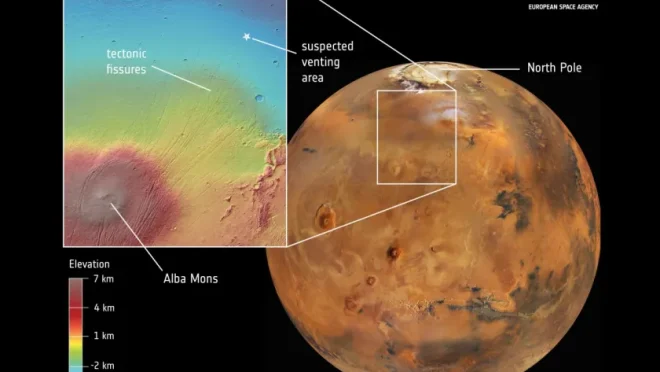
Mysterious gas emissions and fresh fractures near one of Mars’ largest volcanoes suggest that volcanic processes may still be active beneath the planet’s surface, according to a new study.
An international research team has identified unusually high concentrations of hydrogen chloride gas above fractures in the Alba Mons volcanic region, raising the possibility that gases from underground magma are escaping into the Martian atmosphere.
The findings, published in the journal Science Advances, are based on observations from the European Space Agency’s (ESA) ExoMars Trace Gas Orbiter (TGO).
The orbiter first detected hydrogen chloride in Mars’ atmosphere in 2021. Researchers have now identified unusual concentrations of the gas during early summer in the planet’s northern hemisphere, when its levels would normally be expected to decline.
The gas was repeatedly detected above volcanic fractures on the slopes of Alba Mons, suggesting that the emissions may originate from an underground geological source rather than ordinary atmospheric processes.
The team combined atmospheric measurements from TGO’s Atmospheric Chemistry Suite with surface images captured by its Colour and Stereo Surface Imaging System (CaSSIS). The images revealed relatively fresh, narrow fractures, some extending hundreds of metres, along with unusual colour changes around them.
Researchers believe the fractures could act as pathways for gases escaping from underground magma chambers, similar to fumaroles, or volcanic gas vents, found on Earth.
One possible explanation is that ice seals the fractures during Mars’ extremely cold winters, when temperatures can drop to around minus 120 degrees Celsius. As temperatures rise in early summer, the ice sublimates, potentially allowing trapped gases to escape.
“Our findings suggest that Mars has retained enough internal heat to support volcanic activity until recently, and possibly still does,” said Daniel Mège, professor at the Space Research Centre of the Polish Academy of Sciences and co-lead author of the study.
Although Mars is home to the largest volcanoes in the Solar System, scientists have yet to directly observe a new eruption or fresh lava flow on the planet. However, orbital images have indicated that some Martian volcanoes may have erupted within the past few million years, while surface instruments have recorded seismic activity.
The latest findings could also have implications for the search for life on Mars. Researchers suggest that underground volcanic activity could create hydrothermal systems when magma or lava interacts with groundwater.
Such environments could provide warmth, chemical energy and protection from the harsh surface conditions, potentially creating conditions suitable for microbial life.
However, the study does not establish that Mars is currently experiencing volcanic eruptions or that life exists beneath its surface.
Researchers say further investigations of the fractures around Alba Mons, including their possible connection to underground magma chambers, could help determine whether volcanic activity continues on the Red Planet.