450,000 deaths projected from super El Niño in next six months
450,000 deaths projected from super El Niño in next six months
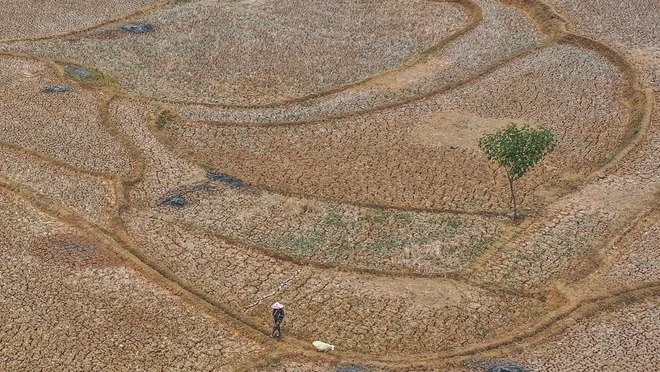
New report predicts a heavy toll from Nigeria to the US, on top of existing impacts of the climate crisis, according to the Guardian
More than 450,000 people are projected to die from the additional heat brought by a super El Niño over the next six months, according to estimates by climate scientists.
The toll would come on top of the early deaths already resulting from temperatures driven higher by the climate crisis. The impacts are expected across the globe, from Indonesia to India, and Nigeria to the US. Many more deaths are expected from the droughts, wildfires and flooding that El Niño events can bring.
The heat-related deaths have been estimated at regional level, allowing researchers to identify where measures to protect people could be introduced to save lives. Such measures could include improved heat forecasts, cooling centres where people can shelter, increased staffing at medical facilities during the hottest periods and greater protections for outdoor workers.
“The estimate of 451,000 people is such a large number that it can be numbing, but it is made up of parents and children, grandparents and neighbours, people going to work, caring for families and living their lives,” said Prof Michael Greenstone, co-founder of the Climate Impact Lab and a professor at the University of Chicago, who co-authored the report.
The estimate covers the period from September to February 2027, which is when current temperature forecasts end. However, elevated levels of heat-related deaths are expected to continue until June or July 2027.
The countries expected to be most affected over the next six months are tropical nations including Nigeria, Indonesia, Sudan, India and Brazil. The US is among the 20 most affected countries, with an estimated 3,500 additional heat-related deaths. More broadly, the Sahel region of Africa and south-east Asia are expected to be heavily affected.
The researchers described the El Niño as a “postcard from our future”, pushing temperatures to levels that the climate crisis is projected to bring about in around 20 years.
“Increasing emergency response and better targeting our efforts can save many lives this year,” said report co-author Dr Tamma Carleton of the University of California, Berkeley. “But 20 years from now, once today’s extreme temperatures become the new normal, we don’t want to be in a constant state of emergency. We need to mobilise now to design, deploy and evaluate the tools that will save lives in the years ahead.”
The projections were made using peer-reviewed methods that track the month-by-month relationship between temperature and additional heat-related deaths across 24,378 regions worldwide. Researchers combined this data with forecasts for higher temperatures caused by El Niño in the months ahead. The baseline was the number of heat-related deaths recorded in an average month between 1996 and 2025.
“People have been able to forecast when there’s going to be shocks to crops, and give advance warning of that,” Greenstone said. “This new report is opening the door to being able to do it for an even more important outcome – I would say the most important outcome – which is death.”
The report will be submitted to a peer-reviewed journal. However, Greenstone said that, given the urgency of the situation, “it would have been irresponsible to sit on it”.
Food supplies are also expected to be affected by El Niño. The World Food Programme warned in August that its impacts could push about 50 million people into acute hunger and drive up food prices.
A major El Niño event in 1877-78 was associated with more than 50 million deaths from drought and famine, with India, Brazil and China among the worst affected.
Prof Friederike Otto of Imperial College London told the Guardian on Monday that the current El Niño was “a huge redistribution of energy in the climate system” and dangerous because it was developing on top of a much warmer, human-influenced climate system.
“So, in many places around the world we will see never-before-experienced heat extremes, with all their consequences on health, food security and water stress,” she said. “El Niño comes and goes, but as long as we continue to burn fossil fuels, it occurs on an increasingly hotter baseline, making it much more difficult for communities to deal with the consequences.”