I went to SANEM Annual Economists Conference 2026: This is what I learned
Participating in the SANEM Annual Economists Conference 2026 was one of the most intellectually enriching experiences of my academic journey. Held from 17–19 April 2026 at the BRAC Centre Inn (on 18 and 19; on 17 the conference was conducted via Zoom webinar), the conference gathered leading economists, policymakers, researchers, and development professionals from South Asia and beyond.
I went to SANEM Annual Economists Conference 2026: This is what I learned
Participating in the SANEM Annual Economists Conference 2026 was one of the most intellectually enriching experiences of my academic journey. Held from 17–19 April 2026 at the BRAC Centre Inn (on 18 and 19; on 17 the conference was conducted via Zoom webinar), the conference gathered leading economists, policymakers, researchers, and development professionals from South Asia and beyond.
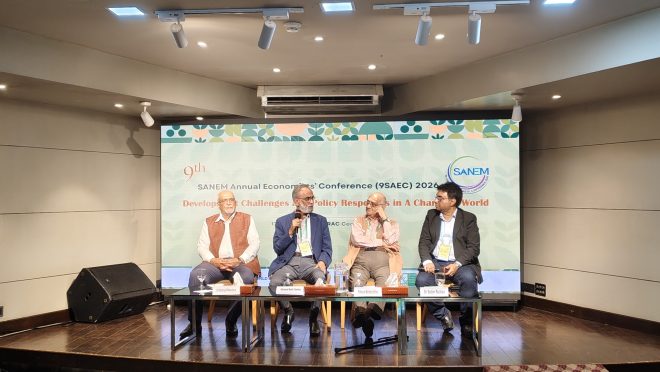
I volunteered at the SANEM conference as a photographer, due to which I could not attend all the sessions. The sessions I attended included Rehman Sobhan’s session, Sadiur Rahman’s lecture, Rajen Krishna Panta’s lecture, and all the lectures from the Dialogue Room and Auditorium on 18 April.
A significant contribution came from Rajen Krishna Panta, Director at Nepal Rastra Bank. He discussed the challenges of regional financial stability and the role of monetary policy in maintaining macroeconomic balance. His insights into financial integration and inflation management were particularly relevant to South Asian economies, where external shocks often affect domestic stability, as can be seen in the current economy of Bangladesh.
The most thought-provoking session, in my view, was the lecture by Mustafizur Rahman, Distinguished Fellow at the Centre for Policy Dialogue. His discussion on balancing global competitiveness with national development priorities reinforced the idea that growth without inclusivity can create long-term vulnerabilities. Among all the lectures, this was the only one I took notes on.
Equally impactful was the plenary speech by Zaidi Sattar, Chairman of the Policy Research Institute of Bangladesh. His argument that trade policy should enable access and adaptability rather than restrict economic activity resonated strongly with current policy debates.
The breakout sessions in Meeting Room 1 and 2, the Auditorium, and the Conference and Dialogue Room offered deeper engagement with specialised topics. One of the memorable sessions was on education policy, presented by Rubaiya Murshid. She challenged perception-based evaluation of education quality.
Gender economics emerged as a crucial theme during the conference. In her presentation, Sayema Haque Bidisha discussed the rising role of women in Bangladesh’s economy. She noted that women-led small and medium enterprises have grown significantly, contributing to both economic productivity and social empowerment.
Technological transformation was another recurring theme. Researchers emphasised that automation and digitalisation are reshaping labour markets worldwide. Discussions highlighted how developing countries must invest in skill development and innovation to adapt to these changes. This theme was further reinforced by sessions exploring the implications of artificial intelligence and job displacement.
One particularly important macroeconomic discussion was led by Zahid Hussain. His explanation of the policy dilemma between inflation control and growth stimulation offered valuable insights into the challenges faced by central banks and fiscal authorities. It also prepared me to write a paper for my next presentation.
Another meaningful discussion centred on technological disruption and labour markets. All the experts emphasised that while automation increases efficiency, it also poses risks of job displacement. However, I could not form a clear picture or full understanding of this argument.
Throughout the conference, the leadership of Selim Raihan was evident in maintaining the academic quality and relevance of discussions. His vision of promoting evidence-based policy research was reflected in the diverse range of topics and high-level participation seen throughout the event, including enthusiasm.
The conference also included several research paper presentations addressing issues such as macroeconomic stability, digital transformation, climate resilience, and trade policy. These papers demonstrated the importance of data-driven policymaking. A particularly unique paper was Women on Motorbike, presented by Sadiur Rahman, Lecturer at Islamic University, Kushtia, under the theme “Gender Economics”.
Another significant learning outcome was the importance of regional cooperation in South Asia. Speakers highlighted that shared challenges such as climate vulnerability, trade barriers, and labour migration require collective policy responses. Regional dialogue and collaboration were presented as essential tools for achieving sustainable development.
Participating in this conference also helped me appreciate the importance of policy communication. These interactions fostered knowledge exchange and encouraged my intellectual curiosity in mastering economics.
One of the most intellectually powerful moments of the conference was the keynote address delivered on 19 April by Rehman Sobhan, Chairman of the Centre for Policy Dialogue. His keynote presentation, The Cost of Denial: How Economic Growth Undermines Governance Reform, provided a deeply reflective analysis of the relationship between economic growth and institutional development. It changed my perspective on governance reform.
Professor Sobhan’s speech highlighted that inclusive growth occurs at the intersection of strong state capacity and social freedom. According to his analysis and my understanding, many developing countries face a fundamental challenge. This imbalance can lead to extractive institutions that benefit only a limited segment of society rather than promoting broad-based welfare.
A particularly memorable insight from his lecture was the concept of transitioning from extractive institutions to inclusive institutions. He explained that extractive institutions concentrate wealth and power among elites, whereas inclusive institutions distribute opportunities more widely and promote social equity. This idea encouraged us to rethink development beyond GDP growth.
For me, as a participant as well as a volunteer, these keynote sessions were particularly impactful because they connected theoretical economic concepts with real-world governance challenges.
As I mentioned, I also served as a volunteer photographer at the conference, which allowed me to observe the SANEM conference from a closer perspective and in greater depth.
Apart from this, snacks, lunch, and dinner were provided throughout the conference in a humble and serene environment. There was no compromise on hospitality.
Overall, attending the SANEM Annual Economists Conference 2026 significantly broadened my academic perspective. The experience deepened my understanding of macroeconomic management, inclusive growth strategies, gender economics, climate resilience, women’s economic cycles, and technological transformation. More importantly, it helped me build a network with economists and professionals beyond academia.
It is a reminder that economics is not only about numbers but also about improving lives and building resilient societies, which I understood as a whole while attending the conference.