The curious appeal of Persian language among Bangladeshi learners
The curious appeal of Persian language among Bangladeshi learners
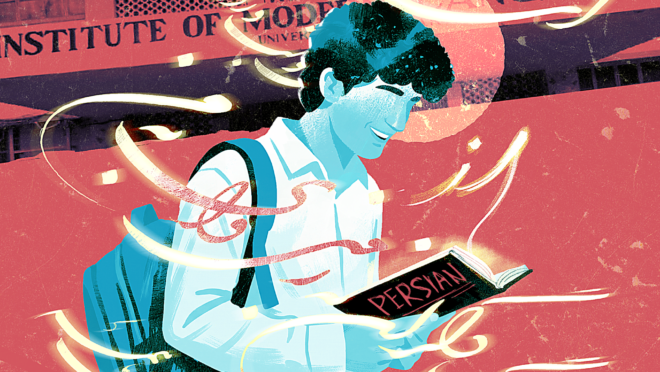
For many Bangladeshis, learning Persian means more than acquiring a foreign language. Motivated by Iran’s historical, cultural and literary heritage, they pursue it for personal and intellectual fulfilment despite limited professional opportunities.
At a time when learning a foreign language usually means learning English, French, German, Spanish or Italian, Jannat (real name withheld) chose Persian.
The interest grew out of her studies in architecture. During her studies, Persian civilisation fascinated her, particularly its architectural heritage, including Persepolis, the ancient capital of Persia, located in present-day Fars province, Iran.
“Being a student of architecture, you must learn about Persian architecture, particularly Persepolis. That is why I am learning the language to gain a deeper understanding of Persian philosophy, literature and culture,” she said.
For many Bangladeshis, learning Persian means more than just acquiring a foreign language. Many are motivated by Iran’s rich literary, artistic and architectural heritage while others are keen to understand its films, philosophy and history. Many are also drawn to Persian by its historical connections with Bengal or by a desire to read classical texts in their original form.
Despite limited professional opportunities, learners are finding personal and intellectual reasons to pursue a language that remains relatively uncommon in Bangladesh.
For Shishir, a film director, interest began with cinema. In 2001, he became fascinated by Iranian directors such as Abbas Kiarostami, Majid Majidi, Mohsen Makhmalbaf, Jafar Panahi and Dariush Mehrjui. Their films introduced him to new ways of looking at the art of filmmaking.
His fascination with Iran deepened as he watched more films and documentaries. He believes Western media coverage often contrasts with the experiences shared by foreign tourists visiting Iran.
“The enormous library beneath the Iran Mall shopping complex in Tehran alone tells you a lot about the nation’s reading habits. We don’t even have libraries. And where they exist, people mostly use them to prepare for BCS or job examinations,” he said.
Another reason Shishir says he is drawn to learning Persian is their love for ghazals.
“Classical ghazals are largely influenced by Persian music. When I started listening to the ghazals and qawwalis of Amir Khusrau, Abida Parveen, Nusrat Fateh Ali Khan and Aziz Mohammad, I realised that ghazals are essentially Persian,” he said.
For Neel Imtiaz, another film director and researcher, Iran’s strength, sacrifice and resilience as a nation continue to fascinate him. Despite the devastation caused by the US and Israel, the country has not strayed even slightly from its ideals.
“For us, art and literature are merely sources of entertainment. I disagree with the way we assign them commercial value. I want to understand how Persians embrace their artists, writers and philosophical traditions. I want to see what philosophy, art and literature mean to them and how they differ from ours.”
Neel’s research primarily focuses on arts and justice. He believes Iranians possess a certain strength that drives them to stand beside the world’s most vulnerable and oppressed people, a quality that even some of the world’s so-called powerful nations lack.
“This courage, faith and awakening are deeply rooted in their heritage and collective consciousness. They have learned to live with death in the palm of their hands. Yet, look at us attending classes here at the Iran Cultural Centre. Do they let us feel even a fraction of the destruction taking place in their homeland? This is more than politics; it is their spirit and way of life,” he noted.
‘Knowing Persian was much like knowing English today’
Ashik Yamin, a human resources consultant, is learning Persian to read historical and religious texts in their original form. His interest in Iran dates back to childhood, when he first began reading about the country through the Iran Cultural Centre’s newsletter, which regularly arrived at his home.
Over time, he developed a desire to visit Iran. When he finally travelled there in 2018, he felt it was a country worth visiting again and again. After his trip, his mother remarked, “Iran is far better than the West in terms of infrastructure.”
“For us, art and literature are merely sources of entertainment. I disagree with the way we assign them commercial value. I want to understand how Persians embrace their artists, writers and philosophical traditions. I want to see what philosophy, art and literature mean to them and how they differ from ours.” Neel Imtiaz, film director and researcher
Ashik finds communicating in Iran difficult without knowing Persian and hopes learning the language will make future visits easier.
Ashik is also drawn to Persian by its historical ties with Bengal. For nearly 600 years, Persian influenced the region’s history, religion, culture, administration and politics. It served as the state’s official language during the Mughal era, and knowing Persian was much like knowing English today. Its decline began in 1837, when it was abolished as the language of administration.
Ashik believes there is another reason to learn Persian.
“Civilisations rise and fall. Western powers are currently in a phase of decline. Perhaps, subconsciously, I also feel that countries like Iran may lead the world in the future. In that case, Arabic and Persian could become languages of influence,” he said.
However, Ashik believes that these countries remain behind partly because they do not promote themselves enough.
Where to learn Persian?
Persian can be studied at the undergraduate level at the University of Dhaka, the University of Rajshahi and the University of Chittagong. The University of Dhaka also offers Persian language courses through its Institute of Modern Languages (IML).
Anyone, regardless of age or whether they are a student at the University of Dhaka, can enrol in the Elementary course. The Elementary Certificate (A1) course consists of 150 hours of instruction and takes one year to complete. After passing the Elementary level, students can progress to Pre-Intermediate (A2), followed by the Diploma (B1) and, finally, the Higher Diploma (B2). The entire programme takes four years to complete.
The application fee is Tk500 for current university students and Tk700 for others. Course fees are charged separately.

For over 40 years, Persian has been taught at the Cultural Centre of the Embassy of the Islamic Republic of Iran in Dhanmondi, Dhaka. Photo: Iran Mirror BD
Speaking about the programme, Chief Administrative Officer Mohammad Golam Mawla said, “Learning a language requires time, effort and money. Unless you can put the language to practical use in return for these three investments, there is little point in learning it. That is why demand for Persian is currently quite low.”
“While classes for other languages receive 200–300 applications, Persian typically receives only 20–30. Not all applicants eventually enrol either. That is why we admit students directly without conducting an admission test,” he added.
However, Persian is also taught under the direct supervision of the Iranian government at the Cultural Centre of the Embassy of the Islamic Republic of Iran in Dhanmondi, Dhaka. The centre has been running its language programme for more than 40 years.
“Initially, the centre’s counsellor taught Persian. Teachers from the University of Dhaka and other universities also attended classes to learn directly from a native speaker. Later, as the counsellor became occupied with other responsibilities, university teachers took over. Currently, teachers from the Iranian International School conduct the classes,” explained Taieba Tabassum, the centre’s Education and Research Officer.
Students from schools, colleges and universities, as well as working professionals and people of almost all age groups, come here to learn Persian. The learners come from diverse backgrounds, including literature enthusiasts, researchers, film lovers, teachers and businesspeople.
“There are very limited professional opportunities that specifically require this language. However, some opportunities exist in areas such as research, the recovery and study of manuscripts, interpreting, museums, curatorial work and teaching,” Taieba noted.
“Since Persian served as the official administrative language of this region for nearly 600 years, many people also learn it to explore their roots. Numerous historical and religious books and manuscripts are documented in Persian, which also attracts people interested in academic research. However, most people come simply out of personal interest,” she added.
Currently, the centre offers Junior and Senior courses. The three-year Diploma programme is temporarily suspended. Each course consists of 100 hours of instruction and runs for six to seven months. The fee for each course is Tk1,200, with no separate application fee.
“On average, we have around 25–28 students across our two batches. Surprisingly, however, enrolment has tripled this year compared to last year. We have admitted a total of 80 students across the two batches this year. Perhaps the current circumstances have increased people’s interest in learning Persian,” said Taieba.