The men guarding Dhaka can barely afford to live in it
Dhaka’s security guards work long shifts for modest wages, making sacrifices on food, healthcare and family life as rising prices leave little room to save or plan for the future.
The men guarding Dhaka can barely afford to live in it
Dhaka’s security guards work long shifts for modest wages, making sacrifices on food, healthcare and family life as rising prices leave little room to save or plan for the future.
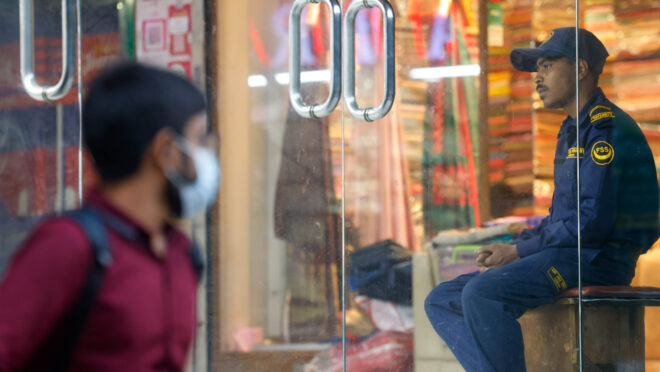
Conduct reveals upbringing, the saying goes, and Murad Ali remembers it. A security guard at a well-known Chinese restaurant in Mirpur, he is the first person guests see.
The 44-year-old has worked there for two and a half years. He can farm, but his father sold the family land, plot by plot, to raise Murad’s siblings.
He lives in Duaripara, Mirpur with his family. In the village, he was the sole breadwinner. Now his son, an office peon at a housing company, and his wife, a garment worker, earn too. His daughter is in class seven.
Murad starts at 6:30 am by sweeping and mopping the stairs, for an extra Tk2,000. After a three-hour break from 10 am, he works from 2 pm to 10 pm.
His salary is Tk8,000, and a share of restaurant sales adds Tk3,000 to Tk4,000. Parties bring the best tips: he got Tk500 at a pre-wedding ceremony on 11 November.
Is he feeling the pinch? “We don’t really shop much for the house,” he said. “My daughter is young, so we get a few things for her. The rest of us scrimp, so higher prices don’t hit too hard. But when guests come, you can’t cut corners. That’s when you realise something is wrong at the market.”
Mushfiq is afraid to marry
Mushfiq, 32, guards a diagnostic centre. He is the eldest son in a family of eight from Jhalakathi Sadar. Only he and his father earn, with a little extra from a fish pond and sharecropped land.
He knows neither farming nor any trades. After higher secondary school, he tried, unsuccessfully, to go abroad. He spent four years making capsule shells at a pharmaceutical factory for a meagre Tk115 a day.
In Dhaka, he joined a security company. Recruits receive a month’s training and two uniforms, followed by 32 days’ annual leave, two Eid bonuses, food and accommodation costs.
From 7:30 am, he finds wheelchairs for elderly and less mobile patients. He earns Tk16,000; tips are banned.
“I have no vices. I don’t even drink tea or chew paan,” he said. “I buy mobile data, call home, watch the news and sometimes have an evening snack. I can send Tk10,000 home.”
And prices? “I’m a bachelor, without many expenses or fancy tastes. But I see married men around me struggling to make ends meet. Seeing all this, I’m even afraid to get married.”
Mohidul is considering a second job
Out of a Tk15,000 salary, Mohidul Islam, 34, spends Tk4,000 on his eight-year-old son’s education and up to Tk2,500 on his wife’s medicines and injections. He sends his parents Tk3,000 and repays another Tk3,000 borrowed the previous month. The rest cannot feed his household, so he borrows again. His saving grace is that he pays no rent.
The owner of the flats he has guarded since 2016 lives abroad and trusts him with everything, including rent collection.
“I could siphon off money, but that’s against my principles,” he said. “The owner is happy with me, so I haven’t looked for another job. But now I’m struggling.”
He comes from the salt-water country of Dacope, Khulna, beside the Sundarbans. In 2009, Cyclone Aila washed away the area’s vast shrimp enclosures, and with them his family’s last means of survival.
His father turned to the forest, catching shrimp and crabs and cutting nipa palm leaves. Weakened and no longer daring to venture in, he gave up about four years ago and now grows vegetables near home.
Mohidul is thinking of driving an auto-rickshaw for part of the day. Or he may go home, though to do what, he cannot say.

For many of Dhaka’s security guards, rising living costs mean difficult choices between household expenses, healthcare and supporting families back home. Photo: Rajib Dhar
‘Eggs are our one luxury’
Yasin Sheikh, 55, earns Tk11,000 guarding a six-storey block of flats, with a room in its garage.
In Dhobaura, Mymensingh, he and his father carried paddy by boat, hoisting the sail in a wind and otherwise hauling it by rope. Married at 17 and told to set up his own household, Yasin built a wooden handcart and carried rice until he was 40. He then moved to Dhaka as a day labourer.
By about 50, that work had become too hard. He became a guard in 2020, on Tk8,000, and later moved for better pay. His wife earns Tk6,000 as a domestic worker. They have no other income, yet pay all a grandson’s expenses. Yasin has bone degeneration in his neck, and a thyroid condition, among other illnesses.
“If I could save Tk30,000, I could buy a cow for someone in the village to rear until Eid-ul-Azha,” he said. “After recovering my capital from the sale, I’d get half the rest. Or with 10 decimals of land, I could lease it to a sharecropper for half the crop or its value. But I can’t find a way.”
His wife said, “I used to be very cheerful. We had hardship in the village, but we had peace. I lost it when we came to Dhaka. Now I can barely cope.
“I buy the cheapest vegetables. Some days it’s rice and mashed potato for all three meals. Eggs are our one luxury. Even then, we cut two into four pieces and make them last two meals.”
‘Now I wonder when guests will leave’
Sabur Mia, 85, guards 120 decimals of vacant land seized by a private bank. He takes the day shift; one of his four sons takes the night. With the bank’s permission, he has built three rooms on two decimals, where 10 family members live.
A former mason from Begumganj, Noakhali, Sabur once owned 80 decimals. The land yielded one crop in four months and lay under water for the other eight. Harvests sometimes failed, and he sold it bit by bit to support his family. He eventually came to Dhaka, and has been a guard for 26 years.
The family eats from one pot. From his Tk10,000 salary, Sabur contributes Tk6,000. His son in Oman sends Tk3,000, the night guard gives Tk6,000 and a hotel-worker son Tk5,000.
“Even three or four years ago, it wasn’t this hard,” he said. “Whatever I go to buy costs more. Gas has risen the most: a Tk1,300 cylinder is now Tk2,000. When I’m ill, I don’t even see a doctor.
“Still, we have to indulge the grandchildren with chicken once a week, if not beef. I used to be happy when guests came. Now I wonder when they will leave.”
Sick or not, a day off costs money
Md Azizul, 19, left school after class eight to earn. Welding paid about Tk15,000 to Tk20,000 a month, but three busy months could be followed by two idle ones.
Just after this year’s Eid-ul-Azha, he joined the Land Force Security Service on his uncle’s advice. He sits by an office door, opening it now and then, from 8am to 8pm.
His Tk12,000 pay includes a rent allowance. He shares a room with three others in Eskaton and eats at a rice eatery on credit, settling a monthly bill of Tk4,000 to Tk5,000.
He sends Tk5,000 to Tk6,000 home, his only saving, and tries to earn about Tk4,000 more through overtime.
The catch is that there are no weekly or public holidays. Any absence is docked from his pay, even for a parent’s illness, a death or his own sickness. When dengue kept him away for 12 days, the company deducted Tk4,800.
“I can save more in this job, and it’s permanent,” he said. “But there’s no leave for anything. When I had the fever and phoned sir to ask for some money, he was very rude. Those things hurt.”
He wants to build his parents a brick house. For himself, he dreams of a Suzuki motorcycle.
Not a taka wasted on ‘good food’
Asif Ali, 28 or 29, guards a well-known bank’s ATM booth on Mymensingh Road, Banglamotor. He has guarded booths for four years.
After joining Best Security Service, he lived with his wife, and later their daughter, in Kalabagan. His Tk13,000 salary for eight-hour shifts left too little for food after rent. Two years on, he was forced to send them home to Mymensingh.
Asif now works 12-hour shifts, sometimes 24 with overtime, for Tk18,000 to Tk20,000. He sets aside up to Tk2,000 for his parents, who live with his brother, sends his wife Tk8,000 and keeps Tk7,000.
His Tk3,000 seat in a mess in a cramped, dirty part of Kazipara, behind Bashundhara City, is not wholly his. While he is on duty, the owner lets it to others by the hour, with no discount for Asif.
Two meals a day cost him Tk2,000, which does not stretch to meat. He has eggs once a week and fish, only tilapia or pangas, twice. Unless someone else is treating him, he will not waste money on good food that his family cannot have whenever they like.
“I send money so they can eat well, but you don’t find many wives like mine these days,” he said. “Even if I go home after six months, she’ll have kept beef for me. I keep telling them to eat it, but they always put some aside.”
All this makes separation harder to bear. Two months ago, using savings and a loan, Asif bought a village plot. Once it is paid for and he has saved a little more, he plans to go home and farm. They may eat less, but they will eat together.
His job brings no tips, but also fewer insults. A friend at an apartment block, he said, was showered with abuse after taking five minutes to free a man stuck in a lift. That evening the man said, “Don’t take it to heart,” and handed him Tk50.
“What good is that money? He’d already abused him! Less money is better, if there’s respect.”
On his own land, Asif will have no “sir” to scold him.
All the guards’ names have been changed to protect their identities.