The house where Dhaka’s poets found a home
Shris Das Lane is easy to walk past. It is narrow and quiet, in the middle of a market that is neither, and the only thing announcing the building halfway along is a signboard over a small gate that reads Beauty Boarding in Bengali.
The house where Dhaka’s poets found a home
Shris Das Lane is easy to walk past. It is narrow and quiet, in the middle of a market that is neither, and the only thing announcing the building halfway along is a signboard over a small gate that reads Beauty Boarding in Bengali.
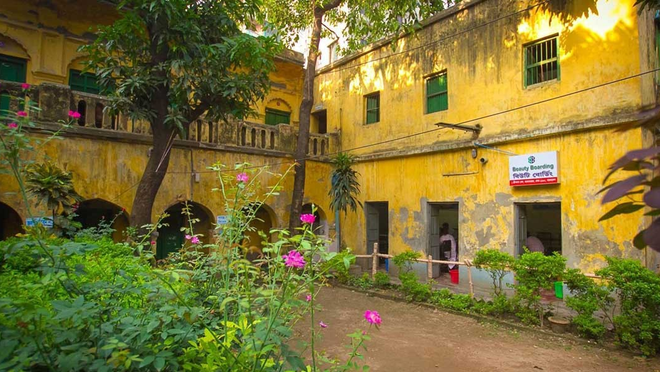
The walls are yellow and flaking in places. Nothing on the outside says that for about two decades this was where Dhaka’s poets came to read to each other, argue, eat, sleep and stay long after they had somewhere else to be.
The lane belongs to Bangla Bazar, older than the Mughals in Dhaka and still the country’s largest book and publishing market. The Buriganga and Sadarghat bound it to the west. To the east is Dholaikhal, named for the canal Islam Khan had dug between 1608 and 1610. To the north is Bahadur Shah Park, where this series started.
I did not plan for the walk to loop back, but it has. The park that opened this series now turns out to mark the edge of the market where this story happened.
By the 1940s, the publishing trade had settled here. Printing presses, binders and stationery wholesalers packed into the same lanes. Traders came from across the country to buy books in bulk, and they needed somewhere to sleep, eat and wait for the next day’s business.
That need helped make Beauty Boarding what it became.
The house before the name
Before it was Beauty Boarding, it was a house belonging to a zamindar named Shudheer Das. Before 1947, it housed the office of the newspaper Shonar Bangla, which published poems and stories by young Dhaka writers, among them Shamsur Rahman, whose first poem appeared there.
After Partition, the newspaper moved its office to Kolkata, and the house sat empty in the middle of a neighbourhood built around books.
Two brothers, Nalini Mohan Saha and his younger brother Prohladh, rented it from a neighbour. They saw what the location offered: a restaurant and boarding house in the one part of Dhaka where book traders had to come. Nalini named it after his eldest daughter, Beauty.
Ahsan Manzil was named for a Nawab’s son. This house was named for a shopkeeper’s daughter. Neither name was meant to become history.
A poet’s invitation
Shahid Quaderi lived in the same lane in the late 1940s. He began inviting friends over to read and talk. The friends were Shamsur Rahman and Syed Shamsul Haq, and then other people came, and then more.
That is how these places usually become important. Not through a ceremony. Someone simply keeps leaving the door open.
Rooms cost two or three taka. Tea, snacks and lunch were cheap enough that a student could stay for hours, and students did. Nirmalendu Goon lived there for nearly five years. Syed Shamsul Haq had a table of his own where he wrote, and the Sahas left it for him. Samar Das, who would go on to compose film music, was a regular.
The brothers’ sons remember it differently from the poets.
Samar Saha, Prohladh’s son, was small enough then that the writers would take him on their knees and give him sweets. That was how he came to call poets uncle. One of them, Zia Ansari, kept the house’s only landline occupied calling his girlfriend, five more minutes at a time. Prohladh Saha teased him about it and never once cut him off.
That is the version of the place I trust most.
Not the famous names. Not the photographs.
A child being handed sweets. A poet occupying the telephone. Someone asking for five more minutes and being allowed to have them.
Adda in this city has always depended on someone who will let you stay too long.
1971
The literary evenings stopped in 1971.
During the Liberation War, the Pakistani Army killed people connected with the boarding house, including Prohladh Saha himself. Sources differ on the number killed, putting it at around sixteen or seventeen. The building was also targeted. Doors and windows were stripped away, along with the water pipes, and for a time the place was left damaged and empty.
The rooms that had once stayed awake late into the night went quiet.
After the war, Prohladh’s widow, Prativa Rani Shaha, reopened the house. Syed Shamsul Haq and Shamsur Rahman, two of the old regulars, came back to help her do it. The rooms returned before the restaurant did.
It took longer to bring the house back to life than it had taken to fill it with people the first time.
What the house kept
In January 1993, Abdul Gaffar Chowdhury, the lyricist of the Ekushey song, returned to Dhaka after years abroad and thought about visiting Beauty Boarding. He later wrote that he decided against it.
The man who had been the heart of the place was dead. The friends from his youth were old or abroad. He asked himself what he would gain from looking at old bricks and wood.
Tarak Saha, Samar’s younger brother, did not accept that the house was finished. He wrote to old boarders and visitors, and in 1995 he and the poet Imrul Chowdhury set up a sixty-member trust called Beauty Boarding Sudhi Shangha. It holds a yearly reunion and gives awards to writers and artists. Young poets began coming back.
And the house itself never quite stopped being a house.
The restaurant still serves lunch. River fish and bhorta. Hilsa cooked in mustard. The rooms upstairs still take guests. You can walk through the same small gate, sit down for a meal, and stay for a while without knowing who sat there before you.
That is perhaps the strangest thing about Beauty Boarding.
The people who made it famous are gone. The arguments are over. The poems have moved into books. The voices that filled the rooms exist now mostly in recordings, photographs and memories.
But the house still does what it always did.
It feeds people. It gives them somewhere to sleep. It gives them a table.
And, if you let it, it lets you stay too long.
Abdul Gaffar Chowdhury decided there was no point in going back. Perhaps he was right. A building cannot give you back the people who once filled it.
But Beauty Boarding survived him.
It is still on Shris Das Lane, still behind the same small gate, still surrounded by the noise of Bangla Bazar.
And people who were never there keep climbing its stairs.
But Dhaka does not end where Old Dhaka does. The same river that carried traders past Ahsan Manzil and brought strangers to Sadarghat once carried people towards another edge of the city, where Mughal Dhaka thinned into fields, gardens and villages. So I followed the Buriganga west, away from the bookshops and boarding houses, away from the streets I had spent these stories walking through.
The river had another Dhaka to show me. This time, there were no Nawabs, no poets, no crowded lanes. Just an old mosque, a forgotten riverbank, and the remains of a city that had once believed this was where Dhaka ended.