Remembering Munier Choudhury
Remembering Munier Choudhury
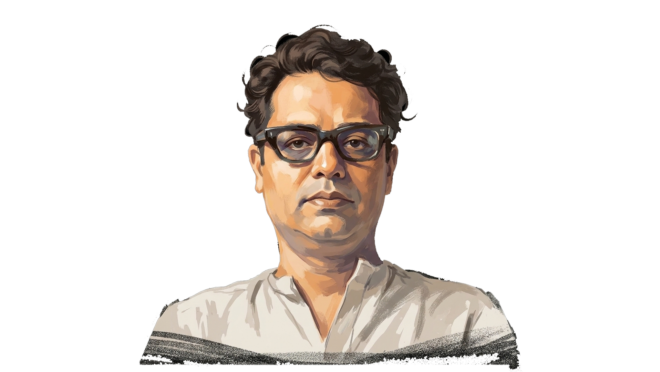
Munier Choudhury was born in Manikganj on 27 November 1925, and a century and a year on, he is still the teacher whom his students at Dhaka University addressed not as sir but as bhai.
Serajul Islam Choudhury, who was his student and later his colleague, recalls that this was a courtesy no other teacher in the department received, and that it came from a charm, warmth and readiness to treat young people as equals that no title could have produced. That detail says more about the man than any list of honours, though the list is long, and it is a good place to begin remembering him.
He was one of fourteen children in a household that his mother named Darul Afia, and his father, Khan Bahadur Abdul Halim Chowdhury, was a district magistrate whose postings carried the family through East Bengal until they settled in Dhaka in 1936.
After Dhaka Collegiate School and an intermediate course at Aligarh, he took his honours in English in 1946 and his master’s in 1947 at Dhaka University, where his leftist politics got him expelled from his hall of residence. He started teaching that same year in Khulna, moved to Jagannath College and then to the university in 1950, and for the remaining two decades of his life he taught in both the English and Bangla departments, rising to professor in 1970 and dean of the faculty of arts in 1971.
The chapter that made him a figure of national memory began in 1952, when he was arrested under the Preventive Detention Act for protesting the police firing on language movement demonstrators. Inside Dhaka Central Jail, in the cold weeks of winter, a secret note arrived from the communist leader Ranesh Dasgupta asking for a play to mark Ekushey, and Munier wrote it in a small notebook, finishing Kabar on 17 January 1953. It was staged in a cell after the prison lights went out, with hurricane lamps borrowed from student prisoners who used them to study at night, and the borrowed light and surrounding dark gave the graveyard setting an eerie authenticity that no theatre budget could have bought.
He later turned the limitation into a principle and said he never again complained about the lack of a stage. He was modest about how it began, remembering that he had to write it because the request came from Raneshda, yet he did not hide his pride in the result, calling it “my best writing that has opened my eyes.” He also admitted that it owed something to Irwin Shaw’s Bury the Dead, an influence he said had worked on him through the subconscious, and he insisted that it meant more than Ekushey alone.
Prison did not slow him down. In 1954 he sat the master’s examination in Bangla from inside his cell and stood first in the first class, which gave him a degree in the language he would spend his life defending. He went on to Harvard for linguistics in 1958, co-wrote an article on Bengali phonemes with Charles Ferguson that drew attention among linguists abroad, and came back to write the critical study Mir-Manas on Mir Mosharraf Hossain, along with comparative criticism and Bangla Gadyariti, a study of Bengali prose. He wrote Roktakto Prantor and Chithi for the stage, and Ektala Dotala became the first Bengali play ever telecast. He translated Shakespeare’s The Taming of the Shrew and Shaw’s You Never Can Tell into Bangla so deftly that audiences laughed as if the plays had been born in the language.
His practical imagination was just as striking, because in 1965 he redesigned the Bangla typewriter keyboard with Remington, a layout remembered as Munier Optima and an early step in the long journey that eventually put Bangla on computers and phones. When Pakistan banned Tagore’s songs from radio and television in 1967, he protested, and when a movement arose to replace the Bangla script with the Arabic one, he opposed that too. In 1971 he joined the non-cooperation movement and gave back the Sitara-e-Imtiaz that Pakistan had awarded him in 1966, which tells us that his sense of belonging to the language and the people ran deeper than any official honour.
Those who knew him describe a man who looked effortless and was anything but. Serajul Islam Choudhury remembers a young Munier answering a joke about Iqbal, that he could turn the poet into a communist, with a cheerful “Yes, I certainly could!”, and then proving it in a lecture delivered entirely in English. The same friend once found him writing at dawn in a Lahore hotel room before a conference, and understood that the apparently spontaneous speaker prepared each remark with care, and that spontaneity is practice made invisible. Humour ran quietly through all of his work, and he said himself that he had always found a certain morbid satisfaction in the grotesque side of tragedy. He also did not pretend to be something he was not, admitting that as a city dweller he could write only for the educated while insisting that the pain and sweat of working people deserved a place in literature, so long as it was written sincerely.
On 14 December 1971, just two days before Bangladesh’s victory, Al-Badr men took him from his family’s home, and his body was never identified. He was forty-six, one of the teachers, doctors, journalists and engineers who were taken and killed in the final days of the war by those who understood that a nation can be wounded most deeply by silencing its thinkers. Two men were later convicted in absentia for abducting and killing him and seventeen others.
Why should he be remembered, and why is he an asset to us rather than only a name on a road, a stamp or an award? He is a reminder that the language movement was carried by teachers and writers as much as by marchers, and that a mind can stay free inside a cell. He shows that scholarship and public courage belong together, that a linguist can design a keyboard and still stand against a ban on Tagore, and that a playwright can turn a prison cell into a stage. For students like us, who live among screens and syllabi, he offers the rarer lesson that curiosity, discipline, warmth and conscience can live in one person. A country that wants a future would do well to keep rereading Kabar and keep asking, as he did, what a writer owes the truth.